
The Interview
An oral history interview for Radical Teacher Interviewed by Joseph Entin and Jocelyn Wills on January 17, 2023. The transcript has been lightly edited.
Jocelyn Wills: Welcome Susan.
Susan O’Malley: Thanks, and before we start, just to say a bit about oral history. When I moved up from the South, when I got a job in New York City, in Brooklyn, I was asked to do a chapter of a book, Moving the Mountain: Women Working for Social Change. And what I wanted to do was to interview Ella Baker. I had not known her in the South, but I sure wanted to get to know her now that she had moved to the North. So Ellen Cantarow and I did nine hours of interviews with her, and in that way I learned a lot about oral history, and how to get people to be responsive. It was an amazing, amazing experience in my life. And then I turned a good part of it into Moving the Mountain. This is Feminist Press, on Ella Baker. And she became a real influence in my life.
So, armed with that, I went and did a lot of oral history with my parents. I was the youngest child, my parents were old. I now have CDs, and my brothers and sisters have CDs, of my interviews with my parents. It took a lot of courage. I didn’t get to all my questions, but I felt like I was now someone who knew how to do social history. And so I got my father to behave and let my mother speak, because he thought he had much more to say. But it was good.
And now I can actually play these CDs and listen to their voices, which is terrifying. There’s one thing about having a parent who has died, but having a parent who’s speaking to you in their voice, that’s scary.
Jocelyn Wills: It’s very weird to put our parents in historical context. You said you came up from the South. I don’t know where in the South you came up from.
Susan O’Malley: From New Orleans, but I’ll get to that.
I was born in Belmont, Massachusetts. Joseph probably knows Belmont. It was quite a nice place to be born. I was the fourth child, and by that time my father was doing very well. They had built this most gorgeous house on Belmont Hill. When they were young they had walked up Belmont Hill and seen an apple orchard, and believe it or not, they built this house with a brook going through it, sometimes it went under the house, and an apple orchard, and windows everywhere. It was beautiful. I think it’s the most beautiful house I’ve ever lived in. Not ostentatious at all. More Arts and Crafts. Lots of wood. Not a garden, and all of that, not big and ostentatious, but gorgeous. And I think that influenced me a lot.
So I went to Belmont schools. Well, first I went to nursery school, of course, and I think I was only put in the bad person’s place once. I was not an easy kid at all.
Part of it, I think, was the forties and fifties. I was born in 1942, in November. They did not believe in holding children. You would cry and cry, and I think if you were Jewish maybe you got held, I can’t see Jewish parents following this. But you cried, and you were not picked up, and you were not held. All bottles were propped. You were not breastfed. And my father wanted to raise me in a Skinner box. He had gone to Harvard and he was influenced by Skinner.
How terrifying I found it was, well, two things. Once, when I brought my firstborn, my daughter, up to Belmont, and she cried, and I picked her up, and I was scolded by my mother. I said, what? Keep quiet. My baby is crying. I’m not not picking her up.
I think that’s one reason it made me so awful. Because the only way, if I was really awful, really bratty, my mother, who was a musician and a violinist, would hold me in her arms and she would dance with me and sing a song about a peddler violinist, whatever it was, that I used to sing to my own children. And that was one way I could get my mother to pick me up and dance with me. There was something about that that was so wonderful.
And with my father, never a kiss goodnight, no tucking in. But he would read a story, and I could sit in his lap. He was kind of tall, and he’d cross his legs, and I could sit in his lap. But that was the only physical attention I got. So I was really difficult.
I was a kindergarten dropout. Everyone in my house, it was a very intellectual house, everyone read all the time. And I didn’t know how to read. So imagine being the youngest, and everyone can read, and you can’t, and you have to go to kindergarten and they don’t teach you how to read.
They were going to skip me, and it was good they didn’t, because I was mature but I couldn’t read. They showed me coins, and I said, well, of course I know this, quarter and nickel. And they asked me if I could tie my shoes, and I said, oh, no, I’ve got brothers and sisters. I was the youngest of four.
So I lasted about a month or two in kindergarten. And it was, one day, coloring these big policemen. They were cut out, and the buttons had to be yellow and the policeman had to be in blue. This is true. But I wanted to do purple and nice colors for the policemen, and I got scolded. And I had just discovered pastels, because an older brother or sister had pastels, and I was so excited about this. And I was told to shut up and follow the rules and make the buttons yellow. So I quit.
My parents weren’t happy with that. But I sat at home, and my mother taught me how to read. She would be cooking or whatever, and I would go, what’s that word? What’s that word? Anyway, they really wanted me to go to school so they could have a little rest from me.
Jocelyn Wills: You describe yourself as awful and difficult, but from my perspective the stories you’re telling, you’re just rebellious. You’re saying, no, I don’t care for the way this works, I want to carve out something different. Would you agree that at a pretty young age that’s how you felt?
Susan O’Malley: I was. But being the youngest, you get to see how older brothers and sisters act. My sister and brother closest to me suffered a lot, and they were just slightly unhappy, and I acted out. My older sister acted up pretty much too. That was survival in the family.
Jocelyn Wills: So your mom was a musician, you said, and your dad went to Harvard. What did he do?
Susan O’Malley: I have to start with my father, Joseph. My father grew up on a dairy farm in Milton. He was the youngest child of a second marriage. His father had come down from Maine with an old overcoat and five dollars in his pocket and become a successful dairy farmer. They lived in Dorchester, but the farm was in Milton.
In the interview he talks about working in the silo, about being a farmer’s kid. They also did a lot of horseback riding, and my grandfather, whom I never knew, was in the Dorchester men’s riding something or other, with sulky racing. He owned the fastest horse, a world champion horse, who was twenty-six years old. There was a cup that said this. But a twenty-six-year-old horse, how fast could they run? Wouldn’t be too hard to win that race, I don’t think.
So his father married a second time, and that was my grandmother, whom I never knew. And she decided that her son was going to be better than a milkman. So what do you do in Boston? You get your child to go to Boston Latin. So off to Boston Latin, and of course you learn Greek and Latin, and he liked to show it off a lot. But he was very smart, and he did go to Harvard.
He told one story in the oral history. At the end of World War I the kids at Boston Latin were so happy, and they were running around screaming and yelling with the joy of the war being over, and the headmaster came down and said, shut up, you Bolsheviki. My father loved telling that story.
Jocelyn Wills: But I presume he was no leftist politically?
Susan O’Malley: Oh, it is funny. He did say, well, everyone went to communism meetings, and he was a bit of a leftist. But then he became a capitalist. So it was a problem, but it was funny. Beside his bed he had Capital, believe it or not. My mother had a Trollope novel.
So, to finish with my father. In the oral history I listened to my mother first, and my father was very impatient and sort of stomping around, thinking that he had the better story to tell.
His mother died when he was at Harvard, so he had to have all kinds of odd jobs. But he got a summer job working at a publishing house, financial publishing, the Financial Publishing Company of Boston. And believe it or not, when he graduated, magna cum laude, he was looking for a job and studying maybe to be an actuary, and he was off to be the president of the Financial Publishing Company of Boston. Two years out of college, or maybe even less.
He really nurtured that company and built a really fine publishing company of financial tables. He majored in English, but he couldn’t figure out how to support children, and so he became head of this company. They did a lot of truth-in-lending stuff.
I worked there once. If he thought a child was smart he put them in the computing room. So I worked with the Univac machine that took up a whole room, and then I worked with the IBM 1401, which had punch cards. I used to read a novel while operating the 1401. That was not good when they would get jammed. I was not happy in the computer room, but I did my best, and when I couldn’t answer a math problem they’d say, are you the child of your father?
I grew up with programming boards, you know, where you have all these cords going different ways. It was fascinating. And they also had a printing press, and I loved to set type. In high school I’d do little dance booklets, and I could set the type.
He was a really interesting man, but quite, quite dominant. And he was a poet. He would write a lot of poetry. He was fascinated with places like Fruitlands in western Massachusetts, and we spent a lot of time walking around where The Blithedale Romance was written, which is actually what I did my master’s on. And when I lived in a commune in New Orleans he was absolutely fascinated. He wanted to come down and see what it was all about. So he had an incredible, wide-ranging mind.
I should tell one story, going backward a little bit, about lack of affection. My daughter Regan is the most beautiful child, with this golden hair, just a bullion. She saw her grandfather, and all the grandchildren called him Grandfather, which I loved, for this man who always wore a three-piece suit. And she runs up to him with her arms extended, Grandfather. And he could not hug her. He could not hug that child. And I learned so much in that action. He was not able to.
Oh, and one more little story, and then I’ll go to my mother, who should have been first, but he takes up so much time.
It was the time of the McCarthy hearings, and that was the bogeyman of my childhood. My best friend was Margaret Ramsey, and her father was in the physics department at Harvard, and then the Furrys were my friends, and we’d go off in the summer with them. Ramsey had been in the Manhattan Project.
So here are the McCarthy hearings. And in ancient history in the ninth grade, the assignment was, what is the most perfect government? Because they were looking at Athens, I guess, and democracy. So, as I often did, I wound up my father and gave him the question and took notes. And damn it if he didn’t say socialism and communism. So, telling your child, who’s going to go back to the public school and say, well, communism is the purest form of government, and explain why.
All I know is that Mr. Conroy looked at me, and then he sort of winked. First he was wide-eyed, like, what’s this child saying? And then he winked, and I could tell that it was okay. But just doing that, I think they had to be slightly mad. As he said, because he was a businessman, he didn’t have to worry.
But I did see my childhood friends, particularly the Furrys. I was in a subway with them, and the newspaper was across the way, and their father’s name was everywhere, because he had been arrested. Furry, and Street, and they were all in the physics department, and they were all Communists. But it was terrifying. Why would someone take away your friend’s father?
When I talked to Ramsey, my friend’s father, he said, don’t worry, I’m young enough. And he did a wonderful thing that I learned about in Ellen Schrecker’s book, actually, that he tithed to all of the members of the physics department, so he could help them pay their legal fees. It was just a beautiful, beautiful thing. I didn’t know about it, but I read about it in her book. And my friend Margaret Ramsey is still my good friend.
Back to my mother. This is terrible, that I’ve spent so much time on my father.
Her father was a pharmacist. I suspect he was an alcoholic. He died fairly young. She went to Catholic school. She was a devout Catholic. My father hated Catholics. He didn’t vote for Kennedy because Kennedy was a Catholic. He really hated Catholics. But he loved my mother, and they had to get married in the church, and he had to promise everything.
She wanted to go to college, but they didn’t have enough money, and she always lamented that she didn’t get an education. She was determined that her four children would get a good education. She was a musician, a violinist, a very warm person, and head of the Girl Scout group, and kind of socially conscious.
One thing that probably influenced things: she had one child, and then she was diagnosed with thyroid cancer. But this was in the thirties, and so she was told she couldn’t have any more children for five years. But the priest gave her permission to use a diaphragm, thank God. They didn’t know anything in those years, and she was treated with something awful, it’ll come to me. I think she hated the treatment so much that she quit it, and I think that probably saved her. But the doctor told my father that she was going to die, and didn’t tell my mother, or my grandmother, who lived with us. So that was a kind of strange upbringing for my oldest sister, to have the husband and the doctor thinking she’s going to die. I think if they had told my mother she probably would have died, and I’m so glad they didn’t.
So that’s one reason my parents were much older, and there’s a big gap in the children.
All my mother wanted me to be, really, was Catholic and a cellist. And I did very well with the cello part. I was the last child, and she didn’t have a cellist in the four of us. She worked at the South End Music School in Boston, and as a child I would spend Saturdays there, where she taught violin. I think she started taking me there when I was four, because it was babysitting, you see. So I started piano when I was four or five, and I knew how to read notes before reading words, which is interesting.
They had one test, and I was just this little girl. You had to walk into a room and sing solfège syllables. You’d walk in and just sing, and then you were graded on it. And I thought that was everyone’s education, that everyone could sing solfège and be graded on it.
I’m very grateful for my music education. It’s been such a joy. So I started playing piano, and as soon as I was big enough I had a cello. I was nine or ten. A little baby cello.
Jocelyn Wills: What do you know about your mom learning the violin in a family that couldn’t really afford to send her to college? Was that a priority of her parents? Did she talk about that?
Susan O’Malley: They really wanted her to have music lessons. My mother was Irish, what can I say. My grandmother was Maud Sullivan, and she was a violinist. I think the whole family was musical. Her father had come from Ireland during a famine, I think the second famine, and he was an orphan, and he ended up in Canada. They promised to raise him Roman Catholic. And then he came back down to Rhode Island, or wherever they were. So it was part of their culture in our family, learning instruments.
She was a very good musician. In fact, just a few words on her. I’m currently working on a book about my grandmother, who was a cellist in an orchestra in Providence around 1898, 1899. Women weren’t allowed in orchestras, so this was a women’s orchestra, and they couldn’t make it as an orchestra. So they all took up wind instruments. My grandmother, the cellist, took up the trombone. She was a small Irish woman. And the cornet, and the euphonium. Another cellist took up the tuba.
So they formed a band that became very successful and traveled throughout the country. It’s called the Helen May Butler Ladies Brass Band. They played in vaudeville, they played in trolley car parks with audiences of ten thousand, department stores, baseball games, all over the country. They played in vaudeville, but they wouldn’t wear tights. They couldn’t be in the union, because women weren’t allowed in the union.
I can go to the Smithsonian, and I’ve gone several times to the history archives, and there are boxes and boxes of my grandmother’s band. I can see all the programs where they played. I can see photographs of their little orchestra, in white, with little flowers in their hair, and then when they were in the brass band, and their reviews, their fan letters. There’s a letter from Sousa, as I remember, because they were called the female Sousa band. I have all of this stuff, and it’s so much fun. But to imagine a group of women in 1899 having enough guts to do it. Well, times were pretty hard in 1899.
One part I’m working on now: they also played coon music. And it’s just what you think, C-O-O-N. This music that makes fun of Black people. I’ve been exploring it as an end-of-Reconstruction thing, the devaluing and degrading of Black people, which is what this music does. I can actually go online and listen to coon music. A lot of the music she played I can now hear online. Not her band, I can’t find any recordings, but the music that she played. There was one Black man who composed coon music, and he was very embarrassed, but he made a good bit of money. The contradictions.
They played in over two hundred places, so I’ve been researching those. And they played when McKinley got shot at the Buffalo Exposition. He got shot in the Music Hall, and they just kept on playing.
So I’m finding this fascinating, especially since I’ve spent most of my life in the seventeenth century.
Jocelyn Wills: You come from a long line of tough women.
Susan O’Malley: And really cool women.
How I found out about the band, you’ll like this, Joseph. I got a postcard, and the postcard was from Martha Vicinus, who would send things to me. Louis said, I think you might be interested in this. So I showed it to my mother, and I said, is this my grandmother? And she said, yes. The Smithsonian postcard, from Martha through Louis to me.
Joseph Entin: A Radical Teacher connection there. Can I ask one clarifying question, which is not a good oral history question, but just for the record. Susan Gushee O’Malley, was Gushee your name as a child? That was your father’s last name?
Susan O’Malley: Yes. Now, this is a tricky name to carry around. G-U-S-H-E-E. But I was the fourth child, and we all went to the same school, so it wasn’t so bad, because when I said Gushee the teachers all knew it. They came to Maine in 1500-something, and they ended up in Appleton, Maine.
Joseph Entin: You were saying that he was not Catholic.
Susan O’Malley: I’m a direct descendant of Miles Standish, because a Standish ended up in Maine and married a Gushee, or maybe there’s one name in between. So that’s kind of embarrassing, to be a direct descendant of Miles Standish. And when I was a little girl you could see the records, and it would say, Susan Gushee, 1942, blank. That was terrifying.
I think that’s enough. But I’m probably much kinder to my family than my brothers and sisters are. My mother was a bit of an alcoholic, I think, being very unhappy, not having the education she wanted. She liked being a violin teacher, but she wanted more. And so she marries a very successful man. She wanted to make sure her children would go to college, and that she wasn’t poor, that they had enough to eat. And she did that. He seemed to love her more than she loved him. But who knows? He provided well, and he sure was a fascinating man. But took up a lot of space.
Joseph Entin: I was curious if you had any memories of your early educational life, whether elementary school or high school.
Susan O’Malley: I pretty much hated school, because it was so boring. I’d learned how to read, and I spent most of my time trying to sit in the back of the classroom with my desk up, reading underneath the desk. My mother came in one time and saw me doing that. It was so boring.
I remember in the second grade they said, we’re going to do a report on a composer. And I remember asking the teacher, could I do it on Schubert? And she told me that, oh, that’s a rare composer.
I went back and looked at some of those teachers. Third grade, she was good. The first and second, they were awful. In first grade I used to try to be sick a lot. It was so boring. And the teacher didn’t know what to do with a bunch of us, because we could read.
But I loved the neighborhood. I loved playing kickball with all the neighborhood kids. I loved that the parents didn’t hover. They didn’t know where we were most of the time. It’s best they didn’t know. We would just get off on our bicycles, a whole gang of us, and take off and go exploring. There were some woods, and high trees I would climb, really high trees. It was nice to have that. Besides, by the time I was born they were tired, so they didn’t pay much mind. But I liked that. Belmont was a great place to explore, places to walk, and totally safe. We didn’t think about things like that.
I went skiing with Margaret and her family, and they taught me how to ski, and it was good. And ice skating. We had the Harvard rink, because Margaret’s father was at Harvard. That was a nice place to skate, and a really good skating teacher for a little while. And Margaret and her father took me to the Science Museum, so I was a Young Explorer at the Science Museum. To be a Young Explorer and see a heart still beating, taken out of a pig. I was going to be a scientist until I was about fourteen.
Joseph Entin: What happened then?
Susan O’Malley: I come from a very literary family, and everyone majored in English or Latin or classics. So at Smith I was either going to be a music major or English, and I went back and forth. But playing the cello two hours a day at Smith, I think, is what got me through Smith. It was quite a shock.
Jocelyn Wills: Can you elaborate on that? Why was Smith a shock?
Susan O’Malley: Class background. I didn’t notice it at the time, but when I look back and see who my friends were. One of my closest friends was from North Dakota. I think her father was a banker, but it was in North Dakota. And another friend’s father was a lawyer, but very progressive. And then there were people like, John J. McCloy, or whatever, I didn’t know that name, but his daughter was in my house. The Nixon kids went there.
It’s a good education. But there were so many kids from private school. If you’re a public school person. And they had a really good education.
I tried playing field hockey there, but the women were twice my size, and when you ran down the field these enormous women would be clumping. So I ended up doing crew. I wanted to row, but I was the smallest one in the boat, so I ended up as coxswain. But I could scream at everybody, which was kind of fun. And my first violinist in my quartet at Smith was stroke, and I loved screaming at her.
I think music saved me. Just practicing two hours a day, and then playing. I could play chamber music and take lessons for credit, so I played a lot. It got much better. It was something transporting me into another realm.
It was a strange environment. It had all kinds of rules. You had to be home at certain times, and I remember hitchhiking back from Amherst and getting home late. Oh, man. I had to go before the board for coming home late. And there was a father’s weekend, and your father would come up and dance with you. That was bizarre.
Jocelyn Wills: What years were you at Smith?
Susan O’Malley: Sixty to sixty-four.
Martin Luther King came up, and lots of people. Interesting people would come by Smith. But there was a sophistication. I found out later that some of the students would use marijuana during their periods. I wouldn’t have known what marijuana was.
Oh, and I had a housemother, believe it or not, who knew F. Scott Fitzgerald, and that actually is in her bio. And she was always drunk. So once I was out with a guy, and she came staggering out of her little apartment, and she looked like F. Scott Fitzgerald, staggers over and goes, she is Scottie. And I go, jeez, let me get out of here fast.
Smith was bizarre, but it was a good education. I loved the seriousness of the education and the demands. I had a lot of friends.
Joseph Entin: Is that where you got interested in literature and the Renaissance and Shakespeare, or was that later?
Susan O’Malley: My father had majored in English. He could quote anything, quoted all the time at the breakfast table. We used to have Shakespeare read to us, especially Sunday morning. And sometimes he would feed me a line, and then I would pop up and say it when he was asking the other kids. So it was a very literary family.
When Truman was running, everyone thought Truman was going to lose. But I only knew Truman’s name. I didn’t know the other person’s name, so I predicted he’d win.
But the funniest thing, this is so embarrassing. We had Shakespeare’s sonnets read to us all the time. “Let me not to the marriage of true minds admit impediments.” Well, when I was four, I didn’t know if it was Truman or true minds.
Oh, and this is important. Every morning when I woke up, my sister Cynthia, the one closest to me, would say, what did Emerson say? And I would have to say, give me health and a day and I will make the pomp of emperors ridiculous. Every morning. Otherwise I would get a hairbrush thrown at me in bed. Isn’t that weird? But I think it helped give me my cheery disposition. Of course we changed it later. It became, give me a night and an Amherst boy.
Catholicism. I was raised as a pretty strict Catholic, and it is so damaging, except that you did learn the Bible a bit, and there are a lot of poets you can read really well, seventeenth-century poets, through my Catholic education. But I think it was extraordinarily damaging to be worried about eating meat by mistake on Friday and going to hell. If you French kissed in Boston, that was a little sin. You go to hell if your tongue just touched. And it’s so destructive of a young person, because you’re always trying to figure out what your sins are, and you have to go to confession and say your sins. How many times can you say, I got angry at my brother? And then you get forgiveness. It was awful.
And then there was the thing about virginity. Believe it or not, my two sisters older than me got married at twenty-two. You had to get married at twenty-two, and you had to be a virgin. Well, those are tough things to do.
I think I am a recovered Catholic. But I know at my mother’s funeral, my goodness. At that funeral I refused to go up to communion. I could not do it, because I hadn’t been a Catholic for a while, and I could see all these people, and they were all staring at me, and I just held my seat. It was hard.
But the virginity thing and marriage at twenty-two is wacko. I think I was a virgin. I’m sometimes not quite sure. But I think the fear was that you didn’t have decent birth control. The pill was starting to come in. And I think my mother had a friend who got pregnant, I don’t know.
Joseph Entin: I was going to ask you about 1964. You’re graduating from Smith, and I’d love to hear more about Smith if you want to say more about that. But the next question I’m curious about is when you became radicalized. That was a really tumultuous moment in American history. What was that period like for you, leaving college, and what happened next?
Jocelyn Wills: And as part of that, lots of people talk about their undergraduate experiences as transformational. I’m wondering if it was transformational for you. I’m not clear it was, given what you said so far.
Susan O’Malley: Wacky, that one. When Miles and I first slept together I said, oh, my goodness, you mean this is what I wasn’t supposed to do for so long? This is so crazy. It’s okay, it’s good, but what’s the big deal?
It was a progressive household except for Catholicism, and except sometimes when my father would be tested. My sister Cynthia had a Black boyfriend, and he wanted none of it, and it was really interesting to see my progressive father. So on the surface it was progressive.
I remember in high school I met my first Communist. It was so exciting. It was the National Honor Society, and we were meeting at Barry Dunlop’s house, and his father had been Secretary of Labor under whatever administration it was, and he was teaching at Harvard, I guess. So he had a real Communist come and speak to us. Somebody Russian, who knew English and could speak to us, and we could ask him questions. I thought that was so exciting.
I think what I wanted most in my life was to have a profession, and I didn’t want anything to get in the way. Because I could see my mother’s unhappiness from not getting the education she wanted, or the job, and I was damned if I was going to stop for anything. The pressure was to get married, you got married at twenty-two, you started graduate school at twenty-one, and you went as fast as you could getting your master’s and your PhD. Because I figured if I got a PhD then I’d get a job, and then I would have a profession. The husband was sort of whatever.
But the pressure to do everything fast. If I had dropped out of college and gone to SNCC, I would have been disowned. I knew about SNCC, and some friends were in SNCC.
It wasn’t really until graduate school, either ’65 or ’66. There was an all-day teach-in at Tulane on Vietnam. I sat through the whole thing. My friend Connie Raymond, who was at Tulane with me and had also gone to Smith, said, Susan, you’re going to sit through this whole thing? And by the end I was. And that did it. That was an extremely important time for me.
Also, when I went south. It was right after the summer of ’64, and I went to New Orleans, and that was a radicalizing experience, particularly about race. Because in Boston you could avoid race. In Belmont there were no Black people, except maids and gardeners and cooks. And suddenly to be in New Orleans was so fascinating, because racism was everywhere, and the laws about segregation were everywhere.
When I first went south in 1963, I was too proud to wear my glasses. We were driving through someplace, and I needed to go to the bathroom, so I walked into the Black-only bathroom, and I got pulled out of there fast. Do you want to cause a riot?
Miles taught for quite a while at Xavier University, which is a Black university, and that was my first teaching experience too. We had Black students living with us. Well, not a lot, one at a time. I’ll never forget this one guy from New York. There are three Black colleges in New Orleans, and one’s high yellow, one’s middle, and one’s very dark, and the racism within that is amazing. So Allen had forgotten his key, and he was just going to lift up the front window of the house and go in, and then he went, oh, if I do that I could get shot. And it’s true. So we sat and waited till we came back with the key.
We would go out in groups, Black and white together, and be treated terribly sometimes. One time they only fed the Black people, not the whites. So we immediately got the FBI on them. We used to do things like trying to rent a house: a Black person would go and be denied, and then I would go and be accepted, and then we’d call them up.
I got very involved because my good friends were Dottie Zellner and Bob Zellner, who had been head of SNCC. So we had this little community together. We also lived in a commune with a group of people, which was very interesting.
So I got quite political, and by the end I was in the October League, for a short time.
Joseph Entin: Just to clarify the timeline. You majored in English at Smith, is that right, and minored in music?
Susan O’Malley: I played all the time.
Joseph Entin: And then you decided you were going to get your PhD. What was the sequence of events that led you to New Orleans?
Jocelyn Wills: Because to me, Susan, that’s also, I do want you to elaborate, because it’s a radical act for a woman to be seeking a PhD in 1964. Not too many women in academia, and not coming from a family where that was part of the expectation. I would love to hear more about that.
Susan O’Malley: I had one cousin who had a PhD in chemistry and taught at Rollins, and she never married. She taught at Smith for some time, actually. So I could see that a woman could get a PhD, and I was very excited about that. But growing up, I didn’t have anyone. You couldn’t have a PhD and a job and a marriage and children. I had no models who did that. I saw a lot of women who were unhappy in marriage, and some who were happy. But it seemed so odd to me. I wanted it all. Why couldn’t you have it all? Men have it all. If I had ranked them it would be job, probably, then children, then marriage.
But I was twenty years old, and I was trying to decide whether I was going to get a PhD in English or go on in music and be a musician. So I spent that summer, I decided if I was going to get a PhD I had to know German. So I went to a Goethe Institute outside of Munich and I learned German, because you had to have several languages for a PhD.
And the musician part. A friend had played in the youth orchestra at Bayreuth, and so I played for a month or whatever in the youth orchestra at Bayreuth. That was amazing. And there I had learned German, and the conductor only spoke Yugoslavian, so that was hard. And there was a cellist who was with the Berlin Philharmonic, and he was a good cellist, but very obnoxious.
That was extraordinary, to do that. My G string broke, and I was so embarrassed to ask anyone if they had a G string. I mean, that’s what I was like. I couldn’t ask this cellist from the Berlin Philharmonic, who was so handsome and such a good cellist, for a G string. I just couldn’t do it. I don’t remember how I finally, maybe I had an extra one somewhere.
By the end of that summer I decided I wasn’t good enough to be a professional cellist. But also politics was so interesting. The musicians practiced all the time. You just practice and practice, because you had to. You played six or seven hours a day. And I wanted to be out doing politics and changing the world. So I decided that being an English professor was the best thing a person could do.
Jocelyn Wills: What made you decide that you wanted to be out doing politics and changing the world?
Susan O’Malley: Oh, it was ’63. The March on Washington was happening, and I wasn’t there. Everyone would be asking about it, and I’d do my damnedest in German to tell them about it. I just wanted to be involved.
And going south was quite something, because racism was so everywhere.
At first I got involved with Women Strike for Peace. I did a lot of anti-war stuff. And then we had a women’s group. I taught a women’s studies course at the University of New Orleans, ’71 or ’72, really early. Black and white students. Teaching women’s studies was so exciting. It was amazing. And the Black women, of course, had me revise my whole syllabus. The men were totally obnoxious, so I had to have a man friend come in and get them into shape by having a men’s consciousness group.
Oh, and I had Steve Ambrose there. The historian, you’ve heard of him, right? I had his wife in my class, and I was so afraid she was going to leave him. And I was asked to be in a study group with him, so I call up his house, and his son says, well, you must have the wrong number, because you’re a woman, and there were no women in the group. But he became a good friend, and we actually organized the union together.
So, back to Joseph’s earlier question, how do you end up in New Orleans? It’s slightly embarrassing. When I came back from Germany, my junior year, I had mononucleosis, very seriously. I had lived on next to nothing in Germany. So I had to drop out of Smith for the fall semester, and I stayed out for I don’t know how long. It was a pretty serious mono, so I didn’t come back till January. But Smith had this January term, and I could make up most of the courses.
Meanwhile my adviser, Lewis, didn’t get tenure at Smith. He was my good friend, and I’d been doing honors American studies work with him. But I didn’t know what was going on. What did I know about tenure? And nobody told me, don’t apply to Yale when you don’t have any fall grades, that’s not smart, wait till you make up your grades and then do a proper application. But I was in a rush, so I got an early rejection from Yale. They said, well, why don’t you have any grades?
So I made up everything, but then it was kind of late to apply. And Kathy Fogel was a good friend of mine, and her father was in the English department at Tulane, and he said, well, just apply, you’ll get in, and we’ll give you tuition or whatever. So I did that.
That’s one reason I did my master’s in American studies and English. But I also had this idea that you could teach abroad if you had a master’s in American studies or American literature. And then when I went on for the PhD I did early modern, and I studied with, his name was Partridge. So I had really good advisers, and that was nice.
Jocelyn Wills: So it sounds like Tulane was kind of a default. It wasn’t your first choice, but it sounds like you learned so much when you got there. And were you married at the time?
Susan O’Malley: When did I get married? I got married in my first year.
Miles decided he was going to marry me across the room. He just decided. He told me that. And I thought, well, why not? He’s in English literature, he’s Catholic, and he’s from Boston. That’s perfect. I didn’t know that he was an alcoholic. I missed that.
So we got married, and he was a lot of fun. I don’t know if you remember Sebastian Dangerfield, that character? Well, he was Sebastian Dangerfield. A great storyteller, a poet, totally neurotic, lots of fun. Drank too much.
But then, this was the Vietnam War, and suddenly he is 1-A. So what do I do? At that brief time, if you had a child the man didn’t have to go to Vietnam. You haven’t heard this story, Joseph. I never told you this.
So we go to the draft board. And there’s a woman sitting there, and they said, yeah, 1-A, we’ll see if your number comes up. And I say, and what if I’m pregnant? They look at me and say, are you? And I said, no, but give me ten minutes.
So it took more than ten minutes. It took two months. And Regan is very happy that she kept her father out of Vietnam.
But then, when Regan was born, they asked what color she was, at two in the morning. And she’s very blond, with this yellowy hair. And I refused to tell them, because I didn’t think it was any of their business. So in New Orleans at that time they went back twenty-four ancestors, for me it was thirty-two, I think, to see what color your child was. In this case they had to go back to Ireland, because the O’Malley was his, and to Maine, and line up all of these ancestors to decide her color. So the birth certificate took a while to come. But her certificate says white in big letters on it. Now, when my son was born, they didn’t do that anymore. But isn’t that scandalous?
Jocelyn Wills: So what was it, the one-drop rule or something?
Susan O’Malley: This was ’66 or ’67. So that was pretty crazy. But he stayed out of Vietnam, which was great.
Joseph Entin: So you graduated from Smith in the spring of ’64, got your master’s in ’65, and then continued for your PhD?
Susan O’Malley: Absolutely. I was in a rush. I took my doctoral exams when I was pregnant with Regan, so that when I got fed up I could pat my belly and say, at least I’m doing something creative.
Joseph Entin: It sounds like you and Miles were involved in an interesting social and political situation there for a while.
Susan O’Malley: When Regan was three or four we were in the commune, because he had decided that our life was too bourgeois. So we had this commune, and it was very interesting, but difficult in many ways. It showed me that my marriage was, well, there’s nothing like having all of these people living with you, seeing Miles drinking, or acting in ways he shouldn’t.
Jocelyn Wills: How many people in the commune, and how long did you live there?
Susan O’Malley: One year, I think. I don’t think it was more than one year. There were six of us. Some of them started a free school, that was interesting. I was involved in it for a while, but then Regan said, you know, I don’t like this, I like to sit in rows, and I like order, I like learning in order. So what could I do? The free school was pretty wild.
But it was good, New Orleans, in many ways, just because it was so different from how I had been raised.
And I got involved with SCEF, the Southern Conference Educational Fund. That was an organization that Anne Braden and Carl Braden organized, and it had to do with getting Black and white people together, working together, organizing in a factory so Black and white people organize together. Because sometimes when a strike happened, management would try to turn Blacks and whites against each other. So it was about building solidarity between Black and white people. It was interesting. I was very, very involved in that.
Jocelyn Wills: Was this all while you were in graduate school?
Susan O’Malley: Yeah. I had a lot of energy.
I got everything done fast, even the exams. My dissertation was working with Partridge on an edition of a play that had never been edited, from 1603 or something. And it was interesting. As he said, look, you’ve got to get through this, and with you having a baby, maybe it would be good that you could get a lot of these documents at home and work on this, and it would be something finite.
But the problem was that I thought you could have a baby and write your dissertation and just rock the cradle with your foot. And so it took me forever to finish. Altogether it took ten years. I did all of it very quickly, and then I took a good number of years.
I had two children, and I remember one time I was very close, and the kids got chicken pox. So I took them to the pediatrician and I said, but I’m finishing my dissertation. And he said, I don’t think you’re finishing it this term. And then the dog had seven puppies. And I was in a crummy marriage. So it was hard. But I did finish. The politics did get in the way a bit, but Partridge was very patient and understood.
One time my dissertation got stolen out of my car, when I was picking up a child at the nursery school. And I got hysterical, and my kids learned the word dissertation. First I put signs up in trees, so all the sanitation workers would be looking for a dissertation, not understanding that they probably wouldn’t know what a dissertation was. But we walked up and down the street near the nursery school. A kid had stolen it because he liked the bag it was in, and the whole dissertation was strewn about, some of it in puddles. But this woman saw me ranting up and down the street, and she said, I think I have what you want. She took me into her backyard and opened her trash can, and there was my dissertation. So I took the muddy pages, and I ironed them and sort of washed them off, and I got almost every page back.
Jocelyn Wills: Susan, was it handwritten, or did you type it? Did somebody else type it for you?
Susan O’Malley: I had an electric typewriter for the final one. But I’d worked on it for a long time. I’ll never forget being so hysterical about that.
Jocelyn Wills: And for those of us who don’t know, Miles was in graduate school at the same time you were?
Susan O’Malley: The same age.
Jocelyn Wills: And what was his dissertation on?
Susan O’Malley: He only did his master’s. It was on Browning.
And, I discovered we were watched by COINTELPRO when we were in the commune. I read that in The New Yorker, believe it or not, about the people who were on this. So we had an FBI agent on us, and then we had another one on us, and that was pretty horrendous when I found all of that out. It’s because we had a commune and had a lot of Black friends, and there was a lot of activity in the commune.
This one agent actually came to Miles’s classes. He went to lots of classes at Xavier. Young students would be asked out to lunch by the police force, trying to recruit them. It was pretty crazy. At the Panther trial, this guy who had spent so much time at the commune, whom we’d been feeding, smoking marijuana with him, turned out to be an agent, and he blew his cover at the Panther trial. We got the Panthers off, which is another story.
We used to go to the courtroom to watch the various lawyers argue cases. It was like the best theater in town. But it was a very exciting time. All kinds of people came to the commune too.
Joseph Entin: Just so we’re clear, when was the year you were in the commune, and when were Regan and your son born?
Susan O’Malley: I think it’s ’67 and ’69. That’s right, because you’re pregnant for quite a while.
And I was in great demand at peace marches, because I had a very big belly. Richard Schechner, I don’t know if you know him, the theater person, the Tulane Drama Review, he would have all these happenings and demos. We actually marched into the ROTC fields at Tulane and disrupted them. We all wore masks, and I had a big belly, so I led that group. We would disrupt ROTC and the college would go wild, and they wanted to arrest us for masking, because you’re not supposed to do that, it’s about the Klan and all of that. So the next time we made masks out of balloons. We had a lot of fun demonstrating and disrupting.
Brendan was, I think he was two, so the commune was probably ’71.
Jocelyn Wills: And what year did you get your PhD?
Susan O’Malley: Seventy-four.
Jocelyn Wills: And you and Miles had gotten married in ’65?
Susan O’Malley: We lived together six years, and then it took six years to get divorced, because I didn’t have enough money, and by that time I’d moved, and he moved up to New York also, and then we realized that this was not going to work. It was hard. He didn’t support us financially much, so that was hard too. But he hasn’t had anything to drink in about forty years, and he stopped smoking, and he’s now married to a wonderful woman. So he ended up really good.
Jocelyn Wills: So when did you move to New York?
Susan O’Malley: Seventy-four. I got my PhD in January 1974.
I was a little desperate. I had sent out some letters, but I didn’t have it in hand, and ’74 was a terrible year to get a job. I had one little nibble from Arizona, but I didn’t have the PhD in hand. So I got it in hand in ’74, and I took the train from New Orleans to Chicago to the MLA. And I got my job at the MLA.
But it was a community college. I don’t know if you remember the critic R. P. Adams. He was at Tulane, American literature or whatever, and I disagreed with him all the time. But he looked at me and he said, well, if you’re going to be raped, maybe it’s good that it’s a good salary. So going to CUNY, to Kingsborough Community College, is just like being raped.
Joseph Entin: You were not at the MLA in 1968?
Susan O’Malley: No. Remember, I was in New Orleans. I had no money. I was not part of that.
Joseph Entin: So how and when did you come upon the Radical Teacher crowd?
Susan O’Malley: Well, I followed New University Conference and whatever, and I was trying to find, I think I told you this before, how did radicals in the Northeast have fun? Because I wasn’t having much fun in the October League. It was enormously exciting, but democratic centralism, really, it’s not for me. Bob Zellner and the people in it were wonderful, and we looked for a group to join. The October League didn’t think that writing poetry or playing the cello were really useful things to do, you see.
And I had organized a union at the University of New Orleans where I was teaching, and it was enormously exciting to do that. I did all the work, and the fancy guy spoke out front. But we were good friends. The historian. Ambrose. I organized the union with Ambrose.
The University of New Orleans said they weren’t going to give me tenure. Organizing the union is not the best way to get tenure. But also they said, look, we’ve got enough Tulane PhDs. And I wanted to leave New Orleans, because I didn’t want to raise children there. My fear was that children never leave New Orleans, and it’s so provincial.
So I went up to New York with my PhD. I had an interview, and this wonderful tweedy Yale PhD was in front of me, and I was sure he got the job. But I was right after him, and I got the job, for some reason. I think it’s because teaching in a community college, you can’t be too fancy. You have to look like you can roll with the punches.
And I told the October League I was leaving, and they got very angry at me, and they really tried to block my coming. I said, I’ve got a job, I’ve got a PhD and a job, are you crazy? I had to support two kids. But they were really trying to block it, because I think I was on the Central Labor Council for a bit in New Orleans. But it was time to leave.
So up I came, and Kingsborough was a real shock.
Jocelyn Wills: But quickly, Joseph had asked how you got involved with the Radical Teacher folks.
Susan O’Malley: When I came up I wanted to figure out how to have fun and to be with interesting people. I think I heard of a call for a meeting or whatever. And so I went to that meeting when Radical Teacher was first proposed, in western Massachusetts. I think it was at UMass. At that meeting somebody told me I was stupid, announced that I was stupid, when I defended Joanna Russ. So that was my first reaction.
But it seemed interesting to do. I wanted to get involved with leftists, and the thought of doing a magazine was interesting. And then we got together at Yale that spring and formed the magazine.
What was crazy, though, was them having Ramy and me as the editors, particularly me, who hadn’t edited anything ever. But why not? So the two of us did it. And of course Dick and Paul and Louis were wonderful in helping us. I learned so much from them, by editing, about all kinds of things. So I was very fortunate to meet up with them. Dick was wonderful. He had me speak at the MLA and come to Wesleyan and talk about something. They were very supportive. And Paul in the editing, he was a little more difficult. But anyway.
Jocelyn Wills: What was Kingsborough’s reaction to your involvement with RT at the beginning? Do you remember?
Susan O’Malley: They hated it. My chair fought it every bit of the way. He said, oh, Susan, you have such a good education, you’re wasting it on that.
He was a medievalist. He was a rabbi. I was told not to shake his hand in case I might be menstruating. It was that environment. And I said, well, I could tell him I’m not. And they said, that’s not professional. But when I had my tenure party, I gave him a big hug. I think he had walked to the event because it was Saturday evening. But I wasn’t menstruating. I would never have done it if I had been, because he might have collapsed. But I didn’t tell him.
It was a bizarre place to be for someone from Boston. I came down there and all the secretaries are eating noodle pudding. And I said, I don’t know what that is. You don’t know noodle pudding? Because I’d never seen a bialy before either. All kinds of things. So I was Miss Outsider.
Jocelyn Wills: Did people caution you, though, that you won’t get tenure if you’re involved with Radical Teacher? Were you worried about things like that?
Susan O’Malley: I was worried. But I out-published just about everybody, except for a few people at the college.
The thing I did that really scared them: some years ago someone wrote this big, massive thing about CUNY, all about teaching at CUNY, and I thought, well, that would be good. So I ordered many copies, and there they were, stacked up in the bookstore. And it was this radical manifesto. But I thought I’d come to New York and it would be radical.
There were a number of progressive people on the faculty who would sort of talk to me. But one of the things they said, and this is wacky, when I was coming up for tenure: the problem with you is, you have too much energy. You out-talk everyone. You out-Xerox everybody. You design too many new courses. You’re speaking here. You do too much. So you don’t know how to respond. Well, okay, so I’ll do less.
And then I got fired. But I got fired because everybody got fired. We didn’t have tenure. That was horrible.
Jocelyn Wills: That was during the cutbacks?
Susan O’Malley: But he wanted to fire me.
Jocelyn Wills: But you got your job back, clearly.
Susan O’Malley: This is pretty crazy. He really wanted to fire me. He was terrible. Leon Goldstein. He was a real thug, but very, very savvy. He knew how to maneuver in the system. He was acting system chancellor for a while. He lied about things on his bio.
You might know about this, Joseph. There was a man who went after me for thirteen years. He sent out hate mail against me. It was awful. I would come to the campus and the secretaries would say, it’s in everybody’s mailbox. And he sent it to all the trustees. He sent it to the whole legislature upstate. He did this for thirteen years. I was red-baited. Red-baited, that was interesting.
Jocelyn Wills: Was he the chair of your department?
Susan O’Malley: No, he was a librarian. He wanted to be head librarian, so he would do anything the president wanted him to do. And there was a group of faculty men who went after me. They went after Barbara Bowen. They went after lots and lots of people. Steve London. But they really went after me, and I think the president got real joy in doing it.
And I didn’t know all of this until one of the deans that I was very close with, a Black woman, after the president died, she told me all about it. She also told me, this is crazy, I had a deep-throat person who would tell me different things, not in her name, and it was that my phone was tapped.
When my father died, I couldn’t believe it. He sent my father the biggest bouquet of flowers, gorgeous. I told the children, don’t you dare take any of those flowers and put them on your grandfather’s grave. They’d come up, and he’d come up out of the dead. It was unconscionable what they did. I’ll gather some of that stuff, I thought it should go in the Kingsborough archives. It was so cruel.
But how I got tenure, I think I can tell this story now. I finally got tenure when I went into the president’s office with my two young children, who were looking very blond and very little. And they said, are we going to the beach? And I had brought a friend who I knew was a close friend of Leon Goldstein. And I got all dressed up, and I looked pretty spiffy. I hadn’t tried that angle before. And he looks at me and says, well, if you don’t get tenure, I want to tell you, you’re such a lovely woman. So I said, all right, Susan, you don’t say fuck you. You say, oh, that’s so nice, but I want tenure. And I said, I want you to know I’m supporting these two children too. I got tenure on the spot.
Jocelyn Wills: But you had the goods too, right? You had to go through all these hoops, but you had the goods for tenure. That’s what’s so crazy.
Susan O’Malley: My dissertation was published, come on. And I’d done this other book. I’d done a lot more than anyone else except one person who was appointed at the Graduate Center. So that’s crazy.
Jocelyn Wills: What year did you get tenure?
Susan O’Malley: If I went there in ’74 I probably got it in ’80 or ’81, around there. I spent a lot of time away from the campus. I was head of the faculty center for the twenty-two campuses, so I was at East Eightieth Street for four years.
Jocelyn Wills: Can we shift gears just a little bit? There’s a question I’d really love to hear you talk about. What does radical mean to you, and how has it informed your teaching?
Susan O’Malley: I think it may have changed over time.
The Vietnam War was such an influence. You could just see that we were on the wrong side of everything. So one thing was seeing the U.S.’s involvement in all kinds of things it shouldn’t be involved with.
But also, in the work that I had done in the civil rights movement. When the Mississippi Freedom Democratic Party got their seats, but only two seats, and they didn’t have proper seats. You could see, even when they were struggling to get that, how awful it was. There were trade unions that sided with the president and blocked the Mississippi Freedom Democratic Party. And I saw that this isn’t working, that if you worked within the terms of the government and in electoral politics you just couldn’t get anywhere.
I had worked in electoral politics in New Orleans to get the first Black member of the school board elected. And we did that. And then he used mace on the students in the local high school who were demonstrating.
So I would try different things. Being in the October League was the most radical. And then, coming to New York, I wanted to work on more local things. So I was part of the Pratt Area Community Council on housing, things more locally where you could see there was change, and there was at least middle-income housing.
I think that’s how I’ve grown politically. Even now, I do a lot of work with the UN, trying to move something from here to there so that it involves more people, or is more democratic, or at least looks to equalizing the needs of people. So I guess it’s changed a lot, but it’s always trying to be on the side of, well, against the rich. And how do you equalize this society? I did a lot of work for the UN trying to develop a curriculum. I’d like to call it socialism, but it was really more social protection kinds of issues. How to equalize things, how to empower.
Jocelyn Wills: How did that influence your teaching?
Susan O’Malley: Oh, well, all kinds of different ways of teaching, whether it was contract grading or using groups. We just kept changing, trying different ways, particularly when I first started teaching at Kingsborough. It was very exciting. Listening a lot. The students in groups.
Just crazy things, like in a Shakespeare class I would say, okay, these books are chosen, but maybe you don’t like them. Do you want to get rid of one and put one of your own in? I mean, that’s hardly political. But then they’d have fierce fights, you know. Yes, I really want to have this one, and that one should go. Just having students in control as much as possible, but with me a part of that.
I loved doing classes in which students would take over part of the curriculum and talk for ten minutes, and then we’d all together explore what they had said. I did a Shakespeare class once at the center, where we’d read a play and then I would teach adaptations and rewrites of the play, and then they’d write their own play if they wanted. So, based on The Tempest, I had a drug lord in the Bronx as Prospero. They did this whole story and wrote their own play. Taking it and making it their own. That was one of my favorite courses, because it demystified Shakespeare. They took it, made it their own, plus looked at movies of some of the plays. And because the center has such an interesting crowd of people, and older people too, it was really empowering. Even classes that went on for two and a half hours were terrific.
I taught at the graduate school some, and that was curious. You had to do so much work. But then the students did a lot of the work too.
I was always experimenting. Oh, and some of the things I loved doing: we would do a lot of team teaching at Kingsborough. I taught a sociology course and an English course together with a Black sociologist, and I loved teaching with her, because the students reacted to her, especially the Black students, so differently than to me. There was this class in which they were talking about things they did in the courtroom to save their boyfriends. I don’t know how it fit in, but it did. They never would have talked to me like that. And the other thing is, she’s much older than I am, but she had no wrinkles, so all of a sudden I was the old one. That was funny.
Jocelyn Wills: Do you want to elaborate a little bit on the UN work you’ve been doing over the last ten years, and how long you’ve been on the board of Radical Teacher?
Susan O’Malley: I was at the beginning. I was at the meeting. I was the first editor, with Ramy Johnson, for ten years, and then he left and left me all alone, which was not great. It took a lot of time.
I loved Radical Teacher, because it was a way of getting to know what people were doing. Every once in a while I’d have fights. I remember one article, I was fighting with Louis as usual, and someone told me it was racist, and it was really interesting to see those points.
It was a lot of work, because everything was typeset, and I had my waxer, and we would cut the type and lay it out. In the beginning we didn’t have footnotes, so we had to cut and put the footnotes in. One time there was a blackout, and so Paul and I, I don’t know if anyone else was with us, laid out Radical Teacher by candlelight, cutting the type and waxing it and trying to get it in the right place. And then once we got that, I had to take it to a printer in Smithtown, Long Island. That was quite a drive. And then it would be sent to Boston, and they would mail it out by hand. Production was very, very different.
I was sometimes intimidated by Louis and Paul and Dick, but they were very generous. They had so much more experience than I did. I really appreciated it. I really loved doing it. My Kingsborough, I hated it, but I just thought this was wonderful. I learned so much, and also a lot about teaching, because I could see what all these people were doing.
And then I did this one book, Custome Is an Idiot, Jacobean pamphlets on women, which was a lot of fun. I wrote a lot of smaller things too. And then, initially with Barbara Bowen, we were researching all over the place, and it was fun.
Joseph Entin: Are there particular board members you remember, or board meetings, or anything that springs up when you scan the history of your involvement?
Susan O’Malley: We used to go either to Boston or to New York, and I can’t imagine that people drove that whole way to do that. But that was kind of fun.
When I started in ’77 you were already meeting in Middletown, and in Louis’s apartment, various people’s apartments. It was quite a commitment, because it’s quite a drive to do on a weekend. But they did it, and then there would be snowstorms and things getting in the way. And then we moved to Dick’s.
I always liked that I could bring my children, and they would be taken care of. They had the members they really liked and would converse with. They’d be happy to see them again. That concern for children.
I loved going to the farm, and we did that starting fairly early, and I brought my children and they had a great time. I love the storytelling at the farm. We would stay up to all hours, and I have never been with such amazing storytellers, and laughing and laughing. I should have recorded some of those.
And having all kinds of conversations. With Bob Rosen, and his pain about Maggie. Or someone maybe had experienced a recent death. People would share and support one another in ways that were really nice.
Of course there was the dancing. I think I’ve told this story. We would have dancing, and we would do the dance of the adjunct, who would be sliding along the floor. And then we told Dick he had to do the provost dance, and strut. So the untenured dance, you’re a little higher, and then the adjunct dance, where you’re just on the floor. Lots of silly things. Great food, great walks. And people helping each other through hard times too.
I had two problems. One was that Saul and I were good friends, and then he didn’t speak to me for years when I called him a dinosaur, which was not nice. And then Louis. He was always problematic, but I thought I got along with him really well. He was always asking about my children and my cello playing. But when I started going around with Dick Ohmann, did I tell you this story? Louis called Dick and said, don’t get involved with her. And Louis was Dick’s closest friend. And so Dick said, do you want to know why? And I said, I don’t think so. So we never asked why. That seems so weird.
I don’t know why he would have told Dick that. All I can think is that I had this Fulbright in London, and I was still editor, or I think someone took over. But people might have thought I was irresponsible to take the Fulbright. I don’t know, because no one really wanted to do all the work.
But it’s been a wonderful, wonderful group. I’m just so lucky. And when you came on, my dear Joseph, I was just so happy when you and Sophie came, because we could start having people younger than us who could take over, and who are so good, and added so much. And now, with the new group, with Neil and the crowd, and Joshua is not too young, but young enough. It’s just so good that we’re alive and have a new generation. Aliyah is lovely. She’s just wonderful. So it’s good that we share the work.
Joseph Entin: Particularly when you were involved in the early days, it was an unbelievable amount of work. It’s amazing for me to think about you raising two children, going up for tenure, organizing at CUNY, doing the publishing you needed to do to get tenure, and doing all of this Radical Teacher production work on top of that. It also reminds me that it was an important support network for you and for everybody on the board. It was more than just having a political project.
Susan O’Malley: They were supportive. When I had my two suicides, Louis was on my doorstep in the morning. That just makes tears come to my eyes. Being there for each other. It’s amazing.
Jocelyn Wills: And that’s rare.
Susan O’Malley: And over all these years. When Saul spoke at the memorial for Dick, I was so amazed, because he could barely speak with his Parkinson’s. That was just an incredible moment.
I feel this a lot, and I haven’t said it, but it’s been very, very important for me.
One of the things that is a problem to me is that the older people will have nothing to do with the website. I’m not great at the Radical Teacher website, but I’m getting better. Certainly I can read and comment on articles and do different things. But I essentially have to do it, or I have to ask Bob to do it. There’s a reluctance. It is a difficult website. It’s getting easier. Linda won’t do it, so if I do an issue with Linda, she won’t touch the website. Okay, I understand. Dick wouldn’t touch it either.
Jocelyn Wills: I think the older we get, the less willing we are to devote enormous amounts of time to learning new technologies that will end up changing anyway. I know I’ve become much more of a Luddite as I’ve aged. So that’s what younger people on the board are for, to stay on top of the technology, so we can just get the wisdom of our elders.
Susan O’Malley: But we got this article for the socialism issue that I would have gotten rid of immediately, and he had put it on the website. But Paul saw something that was useful in one little bit, and I could see it. So Paul did this amazing thing to this writer, telling him how bad it is, but how this little gem is really nice, and he was so thankful, this writer. But you can’t do that very well on the website. On the website I would just say, I could not say yes except with revisions, because it was a mess. But Paul managed to get this guy, who is very bright, to do something decent. I usually just say, read Radical Teacher, will you, before you submit anything. But Paul wrote this whole detailed thing, praising this one little bit and criticizing the rest, and the guy was so happy. You can’t do it on the website.
Jocelyn Wills: In the time we have left, I’d love to know what you see as the challenges and opportunities for younger scholar activists, for people who perceive themselves as radical and want to incorporate that into their scholarship and their teaching. I’d love to hear your advice to younger scholars and activists.
Susan O’Malley: Well, the biggest problem right now is getting people through Covid. I spend some time with a friend at the University of Connecticut, at one of the branch campuses, and she had a disaster of a term. The number of people who didn’t complete, or who were so depressed, who didn’t get to class on Zoom, and how to deal with that. My friend Rusty Eisenberg had the same kinds of problems at Hofstra. My own grandson left, and that was at the New School.
There’s not enough mental health support, not enough psychologists helping these students, and faculty. Friends say to me, it’s so good you left before Covid. And how much that’s going to change what we do, some changes are okay and some are not.
Jocelyn Wills: What changes do you think are okay and which ones are not?
Susan O’Malley: I think some Zoom stuff is okay. Let me tell you, at the UN it’s been so wonderful, because in our international meetings we’ll have people from all over the world talking together, and even families. It’s so exciting. So I think some Zoom stuff is okay.
I think a lot of it is depression among young people. We just got an article for Radical Teacher, I don’t know if anyone read it, about having a course to make the students think of happy things or something.
That’s what I tell friends all the time. Some part of the day you’ve got to do something that gives you joy. You’ve got to find that thing and do it.
Sometimes at Kingsborough it seemed strange, that the community college students would be so excited about reading Shakespeare, or whatever book I was teaching. To find what it is that turns students on. Once I was teaching Fist Stick Knife Gun, and one Black student was so excited. He said, this is my life. He was so wrapped up in the book. And another student said, this book has nothing to do with my life, this is a ridiculous book. So, okay, why don’t we talk to each other?
Just to get the exciting moments in a class. A lot of that takes listening, and being tuned in, and journals, and students in your office.
Sometimes at Kingsborough I’d sit at the ocean, because it’s right on the ocean, and I’d listen to students talk. And sometimes they would get so excited about ideas. This is Kingsborough. They’d be having these intense conversations, whether it’s politics or something they’re reading. They’d get excited reading Plato, and much more radical things. But somehow to get that excitement that you can see in their faces when something connects. That’s what we should be about.
I had students read a lot of Shakespeare and get decked out in costumes. And I loved hearing Shakespeare with a Brooklyn accent. With a strong Brooklyn accent, it’s perfect.
But appreciating students. Listening, nurturing them. Don’t put them down. Ask questions that will get interesting answers.
Once I asked, I don’t remember what we were reading, how many people have access to guns, or have guns in their life? Very few raised their hands. But all the Russians did. Once a student said, you haven’t heard of the Russian mafia? One student, I actually thought, it’d be much better if he had a union.
One time I said, my class was very largely Italian, and I said, you do not mention the mafia in this class.
And one time, when my mother died, I was so upset at teaching. We could have stayed away for a week. And I said, look, I’m a little teary, because my mother just died. I think I wrote about this in Radical Teacher. This very large young woman came up and just helped me for a couple of minutes. She said, it’s important that you survive.
One time when I had been red-baited, and they were saying in the administration that I was in the Communist Party, and I couldn’t say no, because I was to the left of the Communist Party and that would probably get me more trouble. I was so upset. I walked into class and I said, look, I’m really upset, because I was just red-baited in this way. And a student in the back raised his hand and said, you know, you could be in the Communist Party if you wanted to be and still teach. Where do you come from? That was so wonderful. That sort of interaction with students, and getting to know them, and appreciating them.
So I do miss teaching. Community college students.
And I like the UN work. The UN, of course, is disappointing. But what I try to do at the UN is to get the group to assess what’s going on and where they could get to, and figure out, okay, what’s the problem, and how can we move it forward, what’s realistic, and then use my knowledge of the UN to do that. It’s sort of like union organizing too, maybe, but a little different.
So I managed last year to get the document for the Commission on the Status of Women, which all the member states negotiate, much more toward what I wanted. What I did was, a group of us went and talked to a number of the countries that were on the special committee of the commission, and anyone else who wanted to talk to us. And I said, look, I’ve been doing this for a number of years and I’m a total failure. Can you help me? I want to figure out how we can get our recommendations into the negotiated document.
And so they told me. They said, look, you give us your stuff too late. You give it to us before the secretary-general puts out his report, before the draft document comes out. Write three or four recommendations. Tell us exactly what you want in that document, and keep it short. A lot of us don’t know English, and we have two people in our mission, and you send us thirty pages every day. Don’t do that. Be very clear about what you want.
And, why do you spend so much time with the countries in the West? This actually was from Israel. That is crazy. So we put in more African countries. And, why do you spend so much time with big countries? Small countries all have a vote.
So that was really interesting. I followed it, and I did what they said, and I sent it to them. And Germany was the negotiator, and I actually spoke at the mission, and they were wonderful, and we got much more in.
I’ve been doing a lot of work with widows in the world, because there’s no way to meet the sustainable development goals, the ones on women, if you don’t deal with widows. There are so many widows, given Covid, given conflict, because with Covid more men died, and conflict, and migration. And a lot of the laws about migration in countries are really, really bad, particularly around inheritance and land. So I figured out that I could get something in about women’s inheritance, and talk about widows in the recommendations. And I did it with a group. And I was amazed, because so often at the UN people are so well meaning but nothing happens. And then there was a recommendation about widows that got through the Security Council. I didn’t do a whole lot on that, the African Union got it through. That was so lovely.
So every once in a while there’s this stuff. And you make a lot of friends, and that’s nice too.
Joseph Entin: It seems like you’ve been doing that all along, making a lot of friends. And you’re still working on Radical Teacher, you’re working on the socialism issue. It’s amazing, Susan.
Susan O’Malley: Thank you. Migration almost did me in. But I was pleased with the end result. It’s so hard to get articles. We’re doing a little better. But, oh, my God.
Jocelyn Wills: We’re all grateful for your energy, even if your president at Kingsborough wasn’t.
Susan O’Malley: But I did have friends who came. I had wonderful friends too.
I think teaching at a community college is so hard. People feel lesser than, or put upon. Heavier teaching loads too. I just refused to teach more than three courses, and the way I did that was to get grants, or to get release time from the faculty senate, or to be head of the union. One reason I retired is that I had no more schemes I could think of, and I could not teach four and five courses. I couldn’t do it, because you short-change students. You can’t do it, especially reading papers. There’s no way.
And what happened was that I had this friend ten years older than I am, and she said she was going to join this NGO. And I said, well, I’m too busy. And she said, oh, there’s just an opening, just sign on, so when you retire you have something to do. So it led to this whole second career. It’s just been a lot of fun.
Susan O’Malley: I love teaching. I love when it’s a good class. I don’t like bad classes. But good classes, there’s something about it that is so exciting. That expression in the back of the room, of someone who’s made a connection or gotten excited about something.
Jocelyn Wills: And there are different ways of teaching, and it feels to me like you’ve done all of them. You, and the work on Radical Teacher, and all your activism in New Orleans, that was really interesting to learn about.
Susan O’Malley: My adviser was worried I was never going to get through, because of saving the world. My daughter says to me, you have a big personality. I never think of it that way. I have a lot of energy.
And I have a great-grandson. Well, you saw him at the party. Elliot. Did you hear the funny story about Elliot? I guess he’s my great-grandson, I don’t know what you call your granddaughter’s husband’s child. Anyway, he sent me a picture of Elliot, and he’s feeding Elliot with a bottle, and he’s reading to Elliot. I think I told this story at the party. He’s reading Prufrock to the kid. And it’s a video, so I can hear all of Prufrock. And what happened? Elliot fell right to sleep. If you want to get your baby to sleep, read him Prufrock.
Joseph Entin: That works with undergraduates too, I think.
Susan O’Malley: And now I am doing this work on my grandmother, which is fun. But writing is hard. I don’t know how you do it. I love writing. It’s just so lonely. Living by yourself, you can do so many hours and then meet a friend or do something. But it’s the loneliness of writing that’s always been hard.
Jocelyn Wills: Not enough of us share how lonely and daunting writing is.
Susan O’Malley: But what I’m doing right now feels exciting. And if it feels exciting, it’s probably right.
Storytelling, that was the Boccaccio group during Covid. We told stories. There was a whole bunch of us online. It was a lot of fun. So we developed a lot of stories.
Joseph Entin: We should set aside some time at the summer meeting and record a conversation just at the dinner table, of people telling stories. Because, as you say, if we had you and Linda and Bob and Frinde all at the same table, once you hear one person tell one story, that will remind you of another story, or someone else of another story. To do a kind of collective recording, I think, could be really powerful.
Susan O’Malley: And I loved going to your place up at the lake last summer. I hope we’ll do that again this summer. I loved the kayaking and the swimming and the camaraderie. It was lovely.
Joseph Entin: And the place that Jackie found for people to stay was amazing.
Susan O’Malley: Except I slept on the floor. But it was all right.
Joseph Entin: Thank you for everything you’ve done, for Radical Teacher and far beyond. You’re a total inspiration.
About Susan O’Malley
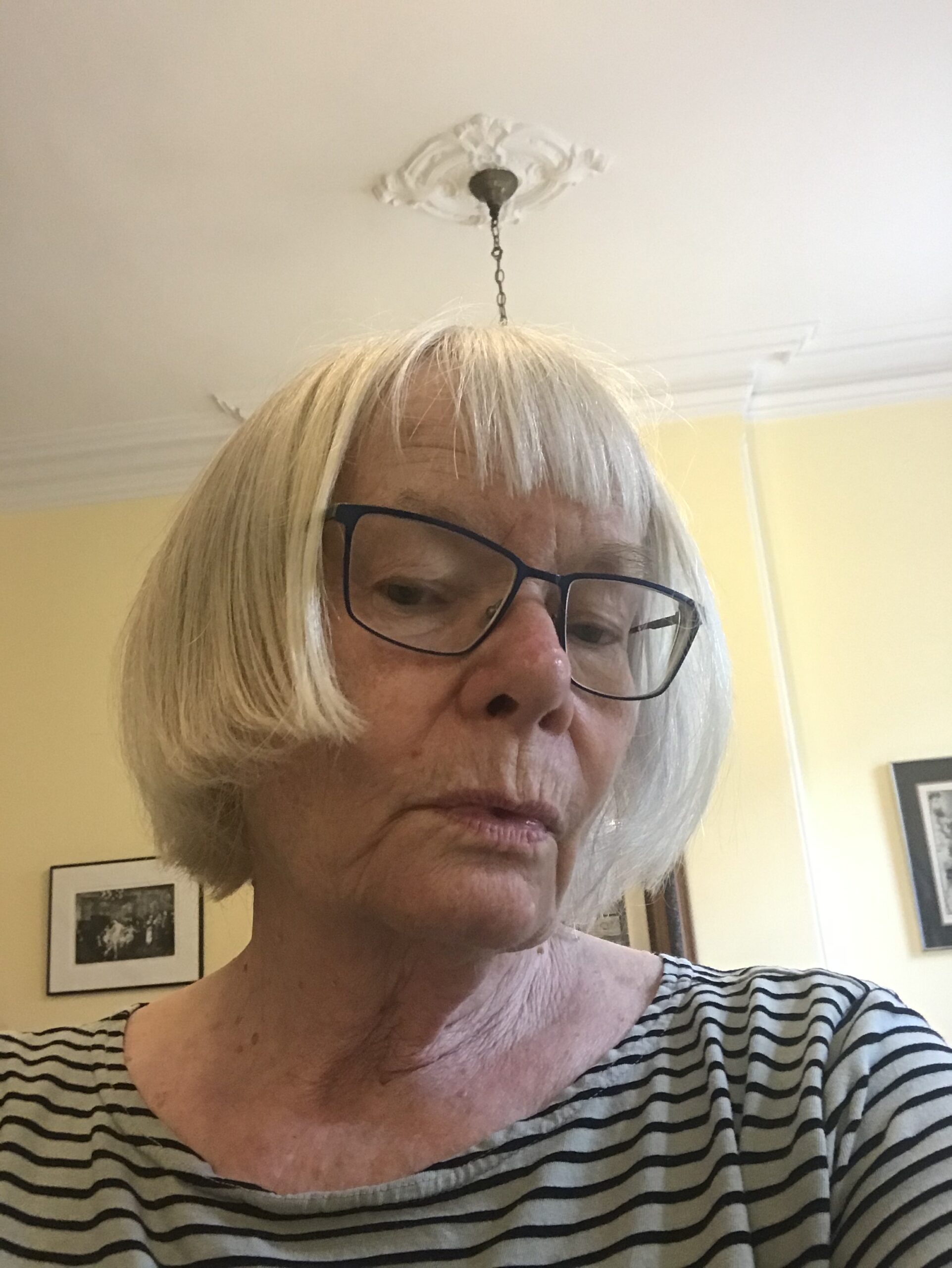
Susan Gushee O’Malley is Professor Emerita of English at Kingsborough Community College, CUNY, a founding editor of Radical Teacher, a longtime union activist in the Professional Staff Congress, and a Renaissance scholar whose second career has been spent representing a nongovernmental organization at the United Nations.
She was born in 1942 in Belmont, Massachusetts, the youngest of four children in a house her parents built on Belmont Hill around an apple orchard and a brook. Her father, raised on a Milton dairy farm, went from Boston Latin to Harvard and became president of the Financial Publishing Company of Boston; he was an English major who quoted Shakespeare at breakfast and kept Capital by his bed. Her mother was a violinist and violin teacher at the South End Music School who had not been able to afford college. O’Malley studied piano from the age of four or five and cello from nine or ten, and nearly became a professional musician.
She graduated from Smith College in 1964, took an MA in English and American studies at Tulane in 1965, and stayed at Tulane for a PhD in early modern literature, completing it in January 1974. She was head of the Kingsborough union chapter, later ran the faculty center serving CUNY’s campuses, and was part of the New Caucus that transformed the PSC.
Her books include Moving the Mountain: Women Working for Social Change (Feminist Press), which grew out of nine hours of oral history interviews she and Ellen Cantarow conducted with Ella Baker; Custome Is an Idiot: Jacobean Pamphlets on Women; the Defences of Women editions; and Politics of Education: Essays from Radical Teacher, co-edited with Bob Rosen and Leonard Vogt. She was Radical Teacher‘s first editor, with Ramy Johnson, for ten years. She is currently at work on a book about her grandmother, a cellist turned trombonist in the Helen May Butler Ladies Brass Band.