
The Interview
An oral history interview for Radical Teacher Interviewed by Joseph Entin and Linda Dittmar January 14, 2026. The transcript has been lightly edited for readability.
Joseph Entin: Okay, I’m going to start. Thanks for being here. I’m Joseph Entin, I’m on the Radical Teacher editorial board, and I’m here with Frinde, Frances, Maher and Linda Dittmar, two other members of the Radical Teacher editorial board, to conduct this interview about Frinde’s life as a radical educator and a member of the board.
Frinde, before we begin, can you say a word about the memoir that has just been published, or is about to be published, just so we can remind people who are seeing this that there’s a lot more information available about your life as a radical.
Frinde Maher: The formal release date is tomorrow, January 15th. The book is called Class Encounters: A Memoir of the 1960s. It’s the story of a very privileged young woman trying to become a useful activist in the turmoil of the anti-war movement, and my attempts to really cross class lines, and both the possibilities and limitations of that journey. It’s being published by a small Boston firm called Tidepool Press, tidepoolpress.com, and it’s available through Amazon as well.
Joseph Entin: Amazing. Congratulations. That’s really exciting, and it adds to the growing library of memoirs by Radical Teacher editorial board members, including Linda’s. Paul Lauter’s published one, so.
Frinde Maher: We all have stories, right.
My book doesn’t really talk about Radical Teacher. In fact, I’m not sure my book even mentions Radical Teacher, except in the epilogue, because it ends in 1971, pretty much.
Joseph Entin: Paul’s is really about the sixties too, and Linda’s is about other things.
You mentioned the publication date, and today is Wednesday, January 14th, 2026. Linda, I’ll start, and you can jump in anytime.
Frinde, I actually thought I would ask you to start just by introducing yourself, in any way that seems fitting to you, and then maybe we can ask some questions about your early life.
Frinde Maher: My name is Frinde Maher, Frinde Aldrich Maher. I grew up as a member of a very privileged family on Boston’s North Shore. I went to Radcliffe College, an adjunct of Harvard University at the time. And I was radicalized by the events of the early 1960s, along with my exposure to people in the civil rights movement and in the anti-Vietnam movement, who seemed to have an understanding of what we were facing as people who were going to be citizens.
I spent the next ten years learning how to be a teacher and becoming an increasingly left-wing activist. I joined the Radical Teacher board in 1984, I think. And I spent the rest of my professional career as a college professor at Wheaton College in Norton, Massachusetts, where I worked in a new academic field called women’s studies, and in a new academic focus called feminist pedagogy.
I retired in 2008, and then had a twelve-year career of counseling Harvard graduate students about how to manage their time, which included dealing with the Harvard syndrome, which made them all think that they were imposters at Harvard. And most of my students were either young men and women of color, or white women. In twelve years of counseling, maybe I saw five white heterosexual guys, who didn’t seem to need any counseling at all, for any reason.
Anyway, that stopped in 2023. But since 2010 I’ve been working on this memoir, on my life, to try to understand myself in terms of the choices I made to really forsake big chunks of my childhood upbringing, only to find out in my later life that much of it was coming back.
One of the blurbs on my book says, you can take the girl out of the elite, but can you take the elite out of the girl? Which was not my favorite blurb. But it does have. Anyway, the memoir is kind of a self-reckoning. I’ll stop there.
Joseph Entin: That’s an amazing arc of your career in five minutes. I can tell you’ve been writing about your life, you’ve narrativized it, which is impressive.
I wonder if we could start by going back. You could talk a little bit about growing up, about your family, your parents, what it was like on the North Shore in the time you were growing up. I’m curious about this question of how people become radicalized. Certainly things happen over the course of a life that change the way we think and feel and act. But I often think there were probably some things back there that happened that might have made you susceptible, or pointed you in a direction. What was it like where you grew up? Set the scene for us a little bit.
Frinde Maher: I grew up in what we would now call a gated community of very big mansions by the seashore. But the first disjunction in my life, probably, was the fact that we lived in our house all year round, and the rest of the people I knew were summer people. They had equally big houses in Boston or Chestnut Hill.
And I always wondered why we had to live in such a big house, where my parents were always complaining about the heating bills. And why we were kind of alone in the winter, there were a few other families, but only a few. And more specifically, why I couldn’t have real Madras shorts when all the other girls had them, and my mother would buy cheaper shorts at Woolworth’s.
It was because my family was house poor. We had this beautiful big house, which my father had inherited. He was an architect. I think my grandmother had money, but architecture is a notoriously up-and-down profession. So it was always about getting the furnace repaired in the winter, and not using the maids’ rooms in our house because they were unheated and there were no maids there.
So from a very early age I found myself wondering why I couldn’t live in one of the smaller houses in the immediate neighborhood, which would be warm and cozy all the time. And yet I loved the view from our beautiful porch, looking out on Marblehead Harbor.
When I was seven, my parents brought home an original cast recording. Joseph, do you remember original cast recordings of Broadway musicals?
Joseph Entin: Sure.
Frinde Maher: Linda, maybe not.
My parents went to opening night of South Pacific in New York, I don’t know why or how, and they brought home the original recording. And there’s a song in South Pacific called “You’ve Got to Be Carefully Taught.” For some reason I memorized that song and thought about it a lot. It’s about how prejudice has to be deliberately taught to children, and taught early, before they’re six or seven or eight, so that they learn to hate the people their relatives hate.
That really stuck in my mind. And whenever I asked my parents about any of this, they would both say, absolutely, clearly, and irrevocably, we are no different and no better than other people. And I believed them, of course. But then things kept creeping in, like, however, you will go to an excellent school, and you will go to an excellent college. So I kind of wondered, if we were just like everybody else, why did we need to have this superior education? And what did that say about the people who didn’t want their children to have a superior education?
WASP families have huge silences. Huge. And I think the silence about what it actually meant to be a member of the class I was growing up in was about money. It was about status. It was about heritage. It was about noblesse oblige. And it was about, never think you’re any better than anybody else, but on the other hand, you have a responsibility to help everybody be better. That is, more like us.
I’m not going to say I chafed against it. Sometimes I thought it was really great that my family was such a special group of people. And that lasted. I was a debutante. I loved it. It was the first chance I ever had to meet boys, having gone to an all-girls boarding school. I was dying to go to Radcliffe and meet Harvard boys. So I’m not saying that I didn’t enjoy, especially as I got a little older, the trappings of class superiority. I did. But I didn’t really think about anybody else. I just thought about, well, I’m going to have a good time at this party.
In my third year of college, November 1963, JFK was shot. And I had moved to a small off-campus house, and I met some people there. Did you ever know Alan Grobar, Joseph?
Joseph Entin: No.
Linda Dittmar: I know his name, but I never met him.
Frinde Maher: He actually wrote some stuff for Radical Teacher later in his life, and he was a friend of Louis. His girlfriend lived in the same off-campus house as me, and there used to be conversations in the living room about Cuba, and Vietnam, and the civil rights movement.
By that time I’d thrown over my preppy boyfriend, and I was so bored. I think I might be one of the relatively few people who turn to radicalism out of boredom. Just crashing boredom. I was so tired of the preppy life.
And among that group of people was this guy called John Maher, also from a really rich family. My family had been but wasn’t. A lot of what radicalized me was being with John. But one of the gratifications of the memoir, I guess, was realizing that I chose him. It wasn’t just that John Maher chose me and then we chose, under his leadership, our life of activism. I also chose him. That is to say, I was ready. I wasn’t plucked away from this comfortable life. I was ready. I was ready to leave the politics of my childhood.
Joseph Entin: Were your parents Democrats, or Republicans? Liberal Republicans, would you say?
Frinde Maher: Nelson Rockefeller was my father’s first cousin. So, they were liberal Republicans. They voted for Eisenhower. I don’t think they voted for Kennedy. I’m pretty sure they voted for Nixon.
They weren’t very, very rich, but they were very philanthropic, and they did a lot of volunteer work in Boston. My father around the Museum of Fine Arts, and my mother as a volunteer at Massachusetts General. Their idea was pretty classic Protestant Brahmin responsibility. And they really meant it when they said, you’re not better than anybody else, of course you have a huge responsibility toward everybody else, but you’re not. They were sincere.
I remember going home in 1964, I’d just graduated, and asking my parents. I’m ashamed to say I asked them and didn’t tell them, that I thought I would go to Mississippi Summer, because some of my friends actually did do that. And my father said, that’s not that so-called civil rights movement, is it? And I said, well. And he said, absolutely not. And I caved.
So he knew about things that were going on. But it wasn’t until 1972, jumping ahead, that John Maher and I went to visit them one day, and my father was sitting in his chair, and his face was gray. He was a very pink-cheeked guy, and his face was gray. And I said, what’s wrong? What’s wrong? And he said, Attica. Which had just happened. And he couldn’t bear it. And he looked at me and he said, maybe you guys weren’t so wrong after all.
And that was the end of it. He never asked us what we, it just, you could tell that there was a kind of understanding in his eyes. He was appalled by Attica.
Joseph Entin: That’s an incredible story.
You were talking before about this transition out of, you said you went to an all-girls boarding school, and then you went from there to Harvard, and it was there that you met John and started to encounter other people who were having political discussions. What was that like for you? I assume the high school was a fairly tame and controlled environment. What was it like to go from that educational world to Harvard in the early sixties?
Frinde Maher: Looking back, there were three things, two of which I understood and noticed, and a third I didn’t understand until very recently.
The first was that it was exciting to go to classes with boys, but interesting classes. Some of the professors were fascinating. I became, sort of glancingly and then increasingly, aware that I was intellectually very curious.
I was also very aware, but thought it was probably the way normal life proceeded, that Radcliffe girls weren’t allowed to use the main undergraduate library. We lived twenty minutes away from the Harvard campus. We were treated as external forces that needed to be protected against by the aging men who ran the Harvard houses, the dormitories. So we were second-class citizens, up, down, and sideways. Which we took for granted. It was ten years before the women’s movement, really. I loved my classes. I was slightly put off by being a girl in that context.
But then I moved off campus, and the living room began to be filled with these people who knew about the civil rights movement, and they knew about the war in Vietnam, and they were going to go to Mississippi, and by the way, did you know that the United Fruit Company was behind the United States domination of Cuba, and did I know about American imperialism? And the answer was, I hadn’t heard a word about American imperialism.
And that brings me back to the third thing that I have since learned about my college education, which was that I majored in something called American history and literature. Which was 100 percent about, basically, white men in New England. Every single abolitionist, and I’m not even making this up, every single abolitionist we learned about was a white male from Boston. Every single one. Except for William Lloyd Garrison, who happened to come from the Midwest.
Never heard about Sojourner Truth, Harriet Tubman, Frederick. Who is Frederick? Frederick Douglass? Who is that?
I never learned that there was a Communist Party in America. I learned about the labor movement, but the labor movement was presented as something that was very necessary to check the excesses of the Gilded Age, and then everything is solved, and now we’re on the road to a better society. Full stop.
And looking back, my education reinforced my God-given sense of innate superiority by coming from the same class of people I was studying about. I mean, how rare is that? Your ancestors were part of the Boston elite, and that goes back a long way, and aren’t we proud of ourselves? That was American history and lit in the 1950s and early 60s.
I had to learn all the American history I later taught. I learned it from Alan Grobar and other people like him in the living room of my dorm.
Joseph Entin: Were there alternative texts circulating? Were people saying, oh, you’ve got to read Frederick Douglass’s autobiography? Was there an alternative curriculum that sprung up in the living room, or was it really just talk?
Frinde Maher: Mostly what I remember was talk. When I describe in my memoir my first apartment with John Maher, we had The Other America, we certainly had the Communist Manifesto, we had Invisible Man. We had all the radical literature of the time. But I don’t remember any of it before I graduated from college.
I want to stop for a second and just ask, so, you two, did you have any kind of awakening, decent college undergraduate educations? I don’t want to take up too much of our time, but what was it like for you?
Linda Dittmar: I was listening to you and thinking, because my years somewhat overlap yours, and it was very different for me, actually. But then I wasn’t an American. I was really an immigrant at that point, in a way, psychologically.
In terms of the curriculum available to me in college at Stanford in the early sixties, and at City College when I was briefly there, it’s what you are describing, for sure. But really, my awakening was not from that. My awakening came earlier, for other reasons. And what I do relate to very much is contradictions within the family. But in mine they were much clearer, and the political context was much different, and in many ways more black and white, more clear. So I know what you’re talking about, but it’s not quite what I went through.
Frinde Maher: Right, we’ve talked about this before, you and I. And Joseph, you were in Sarah’s class. You graduated in ’91, right?
Joseph Entin: High school in ’87 and college in ’91.
Frinde Maher: Did you go to Wesleyan?
Joseph Entin: Yeah. So the curriculum had been transformed, obviously, as a result of the social movements of the sixties. The feminist movement, the Vietnam War movement, the civil rights movement, the queer rights movement. And as a result I walked into the era of multiculturalism. There were African American literature classes, and queer studies classes, and it was a deep, deep critique of American domination, expansionism, empire, class.
It’s really remarkable to think about how radically and substantially the curriculum of U.S. higher education was changed between 1963 and, let’s say, 1985. Just in those twenty-two or twenty-three years it was really reoriented in many ways.
At the same time, I suspect if you went to an elite institution today, let’s say the one in Cambridge, Massachusetts, one is still inculcated with the idea that you’re special because you’re here, and that the United States has a special role to play in the world. I was over in the humanities. If I had been in government, in public policy, in international relations, all of that stuff is still there. So when I talk about how the curriculum was transformed, that was really primarily in the humanities. And even still, I think history departments tend to be much more conservative than, say, some other departments, like American studies.
Frinde Maher: So we did have an effect after all, then, didn’t we?
Linda Dittmar: That’s what the government is so nervous about now.
Joseph Entin: I know. That’s why there’s a huge assault on higher education.
Frinde Maher: I know, but I just think that’s such a vivid, precise description of the differences between the school I went to, and the time I went through, and the time you went through.
Joseph Entin: So whatever my path to Radical Teacher was, it was different than yours. I studied with somebody who was one of the founding board members.
Frinde Maher: Oh, you mean that guy Dick?
Joseph Entin: That one. Dick Ohmann. So certain things were accessible to me. I benefited from all of your curiosity and labors and radical activism.
But this question that you alluded to before, of how and when one becomes radicalized, is always so interesting to me. It sounds like part of it started when you arrived at Harvard and you started encountering people and having certain kinds of conversations. But I’m sure lots of people showed up at college in the early sixties and started having conversations and heard things they had never heard before, and it shook their frame of reference, but not everybody then went on to participate in the civil rights movement, or became a founding member of the feminist movement, or got involved as an activist in the way that you did. So what was the process for you?
Frinde Maher: Well, I moved in with John Maher in the spring of 1965. I had gone to Oxford University for a six-month period, because I really didn’t know what I wanted to do with my life, and I thought, well, I’ll just keep studying, because I love studying. So I went to Oxford for one term. But I’d already gotten involved with John, and he and I basically decided that I should come home, which I did, in January of 1965.
He was working for a senator in Washington called Gaylord Nelson, a liberal Democratic senator, who was supposedly writing a book on poverty, which John was supposed to help him with.
But two things happened. In February 1965, February 8th or 9th, Johnson started bombing the North. And John and I were in New York for the weekend visiting his very radical sister Mary, who’s married to a guy called Levi Laub, who was a great muckety-muck in the Progressive Labor Party, which John and I thought was a ridiculous organization at that time. And Johnson bombed the North, and John, my brand new, I was going to say my brand new husband, we weren’t even married yet, he went to bed for three days. And when he got up he said to me, I’m going to work full-time against the war.
He had independent income from his family in Texas. That’s a whole other, there’s a whole essay on what it’s like to be financed by parents who have no idea what you’re doing, and I think we weren’t the only ones.
But anyway, I needed something to do, so I started work at something called the Dudley Street Action Center, which was an ERAP project. Does the term ERAP mean anything to either of you?
Linda Dittmar: SDS.
Frinde Maher: SDS, Students for a Democratic Society, which had become pretty well known as the main student anti-war organization, decided that they wanted to do some work in the inner cities, and they started something called ERAP, which stood for Economic Research and Action Projects. There was one in Newark that Tom Hayden was involved in. There was one in Chicago. And there was one in Boston called the Dudley Street Action Center, in Roxbury.
I started canvassing out of Dudley Street, up and down the neighborhood, talking to people, mostly mothers, Black women, about welfare reform. And I got to know some of these women, one in particular, and I learned from her. In the memoir I have her telling me everything I needed to know. I’m sure in real life it was more complicated than that, and I talked to more than a few people about the lives of people on welfare, and about the racist structure of Boston’s neighborhoods, and how segregation and bad schooling had thwarted and deformed the lives of Black people in Boston.
And then in April 1965 there was the first SDS march on Washington. Did either of you know anything about a guy called Paul Potter?
Linda Dittmar: No.
Frinde Maher: He was the president of SDS at the time. And he gave this speech at the April 1965 march in which he said, we have to name the system. He put together this incredible speech about the people in the South struggling for their rights, and the people in Vietnam struggling for their independence and their liberation from American forces. He just put it all together. He said, we have to name the system, and then we have to change it.
And I was hooked. I thought, yes, this is what I want to be doing, and these are the people I want to do it with.
And meanwhile I started training to become a teacher, and I married John. We went to demonstrations and stuff, but what I was doing was figuring out how to be a radical teacher. My first year I got a master’s degree at the Harvard School of Education, which did not teach me how to teach. And then a year or so later I started teaching at Wellesley High School, and very happily figured out that being a radical teacher was a real thing.
I spent six weeks in the fall of ’67 on the American Revolution, because I decided to compare the American Revolution to the struggle of the North Vietnamese people. And I had a great time. I don’t know what the students thought.
Linda Dittmar: Frinde, can I go a step back? Why did you decide to be a teacher at all? You could have continued studying history or something.
Frinde Maher: I loved history. And I wanted to be some kind of activist in relationship to American history. And it seemed as though being a teacher would be the best way, maybe even the only way, that somebody like me could use what I knew and tell other people about it.
However, there was another thing. I don’t remember if it’s in the memoir or not. I have a sneaking suspicion it isn’t. I went to see the Dean of Radcliffe when I was a senior, and I asked her if she thought I might be able to do graduate work in history, get a PhD in history. And she said no. The grades aren’t good enough.
Linda Dittmar: What?
Frinde Maher: She said, no, you could never be a history professor because your grades aren’t good enough. You couldn’t go to graduate school in history because your grades aren’t good enough.
Linda Dittmar: Whoa.
Frinde Maher: And she meant Harvard. Which I didn’t realize for a very long time afterward. If I had said, excuse me, and walked out and walked down the street and applied to the University of Michigan, let’s say. Or there was a professor called William Appleman Williams, who was a very, very well known radical, I mean left-wing, professor of American foreign policy. I could have gone and studied with him. I probably would have gotten in. But I was still in that little, you know. She said, basically, you don’t have it to become an American history professor.
Linda Dittmar: I want to say, given our closeness in period at the time, that there was in general an assumed discouragement for women to continue beyond their BA. So it’s not necessarily even what you are surmising, that you can’t go to Harvard. It might well have been simply, you need to get married and have children.
Frinde Maher: I wonder about that. At the time I just thought, well, I’ll just go to Oxford and see what I can figure out to do. And then by the time I got back and started living with John, I also thought, how hard could teaching be?
And I almost flunked out of my MAT program, because I had seventh graders who threw things at me in my student teaching. I taught myself how to be a teacher.
Joseph Entin: It seems to me that that’s a period when some substantial number of women did start to enter academia in the United States. But still, I’m sure many were also dissuaded who might have otherwise done that. I think both of those things are true.
Frinde Maher: I think so too. And I ended up being a college professor anyway.
Joseph Entin: Teaching is about educating other people, but also, of course, being educated. What did you learn when you started to teach, about yourself, or about the world, or about what you wanted to make happen?
Frinde Maher: What a good question.
There was a group of people in Boston at the time, let’s say in the mid-sixties, called the Red Pencil, of course. As it would be. It was a group of people who got together, and we called ourselves radical teachers, and we talked about teaching. And we talked a lot about how to engage the kids. Because one of the things that was kind of central to high school teaching was creating, instead of lecturing, creating conditions under which the students could teach themselves, basically. So I did a lot of role playing, a lot of thinking about the students’ lives, and how American history could have meaning for them.
And in the middle of all of that, five of the people in this teaching group decided to write a curriculum about Vietnam. So we did. It was called the Vietnam Curriculum, and somebody of my generation took the Vietnam Curriculum to Vietnam about two years ago and gave all four volumes of it to the Vietnamese government. It was so exciting that they’d done that.
It was published in ’68, and it had a lot of really good teaching materials in it, including a role play about the case of a guy called Bob. I think his name was Bob, who was being drafted. And what would the students advise Bob to do?
This is in my memoir. I thought, well, here’s this great thing, the students are going to be able to talk about what Bob should do. And they got this role play, and they looked at the paragraph about Bob, and they all just went completely silent. Like, I don’t want to talk about this. You can’t make me talk about this.
And I remember thinking, this is too close to home. I learned a lot about tracking. Wellesley High School, and South Boston High School, and Brookline High School, all the high schools I taught at, had some very severe tracking in history, based on tracking in math. There’s AP and honors, and I always taught the basic classes. And so these kids didn’t want to talk about the draft with me. And excuse me, it was none of my business.
So I said, oh, pretend you’re a friend of Bob’s, or his girlfriend, getting away from, distancing it from them. And then there was a discussion which finally got around to the war.
But what I learned was a lot about the class structure of even elite high schools. Brookline High. Wellesley High. Not a fun place for the working-class kids in those towns. And I taught them, and they were really pissed off at the rich kids. They were wonderful. I had crushes on all of the boys. They were so smart and so pissed off. They’d come into class with cigarettes rolled up into the sleeves of their t-shirts, they’d swagger in, and they were so cute.
Anyway, I loved the students. And every single day I had to re-prove myself to them. And I learned to make teaching about their lives, too.
Joseph Entin: I was going to note that you started off by talking about trying to make history relevant to them, and make them actors in the classroom, never mind in history. And those were brand new ideas, right? That was not at all the way that teaching was set up, and was expected to function. All those ideas that now I think of as products of the sixties movements, that have become institutionalized, the idea that learning should be student-centered.
Frinde Maher: That’s right. And group learning, all that.
Joseph Entin: And that there should be a range of activities in the classroom, and you want to activate your students. I assume there was nobody in the educational establishment who was talking in those terms. But it sounds like you and other people who were trying to think in anti-authoritarian ways started to think pretty quickly about the classroom as a space, and about education as a project or a practice, and how it had to be transformed. It wasn’t just that you wanted to provide information about American imperialism and Vietnam and war, but that the act of teaching and the act of learning and the dynamics of the classroom had to change.
Frinde Maher: Well, for one thing, you’re right in many ways, but there was a very strong heritage. There was John Dewey. And actually, in spite of all my fulminations at our meetings, there was Paulo Freire. There were writers, especially in the early sixties, who wrote about this. There was Paul Goodman’s Growing Up Absurd. There was Edgar Friedenberg, who wrote a book about teaching. There was a man called John Holt. There was Sylvia Ashton-Warner. There was a legacy from all the postwar period. Well, Dewey was much earlier.
Joseph Entin: Twenties, thirties.
Linda Dittmar: I feel like some of it was developing not through the teaching, but also coming from the students themselves. I was at UMass already by ’68. As an adjunct, but I was already teaching, and there were ways in which the students were raising questions that were ahead of, or different from, what I was going to say. Now, it’s true that they were more working-class students.
Frinde Maher: And they were older, weren’t they?
Linda Dittmar: Some of them were older as well. We later started getting Vietnam veterans, but not at that time. They were coming really off the street, who knows from where.
But I remember, for example, teaching “Shooting an Elephant” by Orwell, and the students asking me, is that relevant? In fact, the word relevant was very much in the air. They wanted everything to be relevant. And it was hard for them to see that shooting an elephant is relevant. But nonetheless, they were pushing us, in a way. They were sitting in in different offices in the university, and leading us too. It wasn’t only we who should get all the credit for that.
And another question and observation, maybe, is that you were talking about these wonderful working-class boys, but you were not talking about the working-class women in the classroom. The working-class women early on were quite quiet, until feminism burst through. And again, the question for me, and it’s not a question to you, it’s just on my mind, is things that are in the air before we give them a name. It’s brewing. Eventually it gets known, but it was in the making before we knew it was in the making.
Frinde Maher: That’s really, really well put. And I was mentioning the boys just because I’m talking with you two, and it’s fun to think about Larry with his cigarettes pushed up.
But there were girls in those classes, and some of the girls were pretty feisty. They were mostly children of workers in the town of Wellesley, so the kids of the cops and the workers in various places in the town. And the girls were pretty forthright. And at Brookline, I didn’t write about this in my memoir, but at Brookline I had a group of girls in American history who were all from the same housing project, and they were like 65 percent of the class. And by that time I was a pretty experienced teacher, this was ten years later. But one day they all came into class on roller skates and started roller skating around my desk. Like, just in case, Mrs. Maher, you thought you had any control over the situation, you are wrong.
But yes, I think you’re right, Linda. What you’re saying, which makes me so grateful, really, is that all these ideas were in the air. I could always find somebody, even without my Vietnam curriculum friends, I could always find people to talk to and people to agree with what each of us was trying to do. I could no more have done any of this on my own. Up until 1968 it was just like fresh air all the time. So exciting.
Joseph Entin: What years are you teaching in high school?
Frinde Maher: Wellesley was the fall of ’67 to February of ’69, when I stopped teaching to have Sarah. And then I went back in the fall of 1970 for a year at South Boston High School. And then a couple of years later I did five years at Brookline High. And then I went to college. I had my doctorate by that time, and had gone off to Wheaton.
Joseph Entin: So obviously a lot happened between, let’s say, the mid to late sixties and the moment in the early eighties when you got connected to Radical Teacher. A lot of things happened in your personal life. You had some children. Some things happened politically in the world. The war dragged on for a while, and then in the seventies it culminated with the election of Ronald Reagan. And then you eventually got your PhD. Was it in education?
Frinde Maher: I got an EdD, I didn’t get a PhD.
Joseph Entin: So I’m sort of asking this huge question, but how would you want to talk about this period of time across the 1970s and the way that eventually brought you to Radical Teacher? What you learned about teaching, and how your sense of being a radical teacher changed as you moved across these different contexts, whether it was teaching at South Boston versus Brookline, or then eventually at Wheaton.
Frinde Maher: The Vietnam War ended in 1975. And my first marriage ended in 1979. And that was the era I was teaching at Brookline High School.
But I really had left the movement, or, I should back up. John Maher joined the Progressive Labor Party in 1969. And I never quite joined the party, but I was in a lot of study groups, and selling Challenge. Footnote, discuss this with James Davis.
And then in 1971 the war was still going on, and Nixon bombed Cambodia and everything, things got worse and worse. But in 1971 my son Matthew was born, and he was born with a severe cleft lip and cleft palate. He needed a lot of operations, and I basically dropped out of politics for a couple of years.
And when I went back, at Brookline High School, I discovered how much I’d missed teaching, and really how much fun it was to try to figure out all the things we’ve just been talking about. How do you reach these kids? What’s the connection going to be between their lives and American history, and how can I figure that out? It was a wonderful teaching time for me, because I really felt like I knew how to do it.
I’d do things like, I’d give the students a blank map of the United States, with the rivers and the mountains and the coasts and everything, and I’d say, okay, you’re really tired of living in England. You want to come to this new country. Where are you going to go? What are you going to do when you get here? What kind of a community are you going to set up? What’s the government going to be like? How are you going to farm? And the kids, it’s like, inventing a country. How cool is that? And then I’d say, well, okay, you’re the Puritans and you’re the Pilgrims, and this is what. It was wonderful. I had such a good time.
And then I did my dissertation on the social studies teachers at Brookline High School. And then I left. By that time John and I had gotten divorced, for other reasons. And I started teaching at Wheaton, at the very moment that Wheaton College, which was all women at the time, got a grant to integrate the study of women into the undergraduate curriculum. In other words, anybody who’s interested in doing women’s studies, come and get some money from us. So that launched the feminist part of my career.
But I never let go of socialism. A lot of feminists, I mean, the people at Wheaton were pretty radical. One of my boyfriends was a guy called John Miller, who’s very active in URPE. Remember all that? In the late sixties, early seventies, all these radical versions of every discipline came into being. There were people at Wheaton who were members of the radical history caucus and the Union for Radical Political Economics. We were beginning to do it, Joseph, and to be part of it was so exciting. So thrilling.
And then I started studying pedagogy, because I’d been thinking about it for such a long time. What makes a feminist teacher? And I did those interviews and worked on that book with my colleague for about eight or nine years, and published a book called The Feminist Classroom in 1994.
And then in 1984, I remember I’m sitting in the library of the Harvard School of Education, where I used to go and just do work. And I got a telephone call from Louis. And Louis was an old friend of John Maher’s and mine from the sixties. I think Louis had been involved in Vietnam Summer, which was one of John Maher’s things that he did, in ’67. We used to have dinner with him, and a little bit with Ellen, I don’t remember her as well. But we were friends with Louis. And Louis calls me up, even though John Maher and I had been divorced for five years by then, and he said, there’s this magazine.
And I said, great, how cool, what a great idea. I mean, it wasn’t just an idea, RT had been around since ’76, right? I’m sure you learned all about this from Paul. But he said the meetings are in Connecticut, and if you’re interested in joining the board, come and talk to us. And I was very ready. I was very excited.
Louis and I did the mailing. Well, Linda and I were manuscript editors for a while. Before that, Louis and I were the people who did the mail.
Joseph Entin: That was important and arduous work. Thank you for your service.
Frinde Maher: We complained about it all the time, but basically we had a good time. We had a really good time.
Joseph Entin: What do you remember about Radical Teacher when you first joined, either about putting together the magazine, or about the meetings, or the socializing, or the controversies, or debates?
Frinde Maher: I remember being really excited about working on the first feminist pedagogy issue. It was issue 41. I say the first, maybe there were two, maybe there was just one. Issue 41, Feminist Pedagogy, and we were very excited about that. I remember reading manuscripts, of course, with Linda. I remember working really hard on editing that issue.
I remember, however, some big fights at meetings. And the one that I remember the clearest was, I was a big fan of a feminist, dare I say the word, deconstructionist college professor in education at Wisconsin, I think. Her name was Elizabeth Ellsworth. She wrote this article about teaching which blew me away, and I wanted the magazine either to publish something she’d written, or something about her.
And my dearest friend on the board, aka Louis Kampf, as you can imagine, went ape shit on me. He was furious. He said, this deconstruction stuff is bullshit, and what are these women doing anyway?
And I remember, it was not the only time we’ve had discussions and arguments that I’ve been part of, but this one, I just thought, oh my god, what have I gotten into? And I lost the argument. We certainly never reached out to Elizabeth Ellsworth.
But I look back on it with great affection, those moments. Because for me, postmodern approaches to gender were really important in the classroom, because they allowed me to help students play with their identities, which is what I wanted them to do. So it wasn’t just that I was having fun with these ideas. I was really using them in my classroom.
Linda Dittmar: I would add to that, Frinde, that to me deconstruction was important, but Radical Teacher was not a place you mentioned it.
Frinde Maher: Exactly. That’s exactly it. It wasn’t just that Elizabeth Ellsworth was, quote unquote, a girl, but that she was a deconstructionist. Looking back, I think at the time I thought that Louis was just being sexist, but now I think he was also, remember, Lenny Davis ran into that too, didn’t he?
Linda Dittmar: Yes.
Joseph Entin: And sometimes it feels like the stakes are so high on this little conversation about whether we’re going to publish this particular essay, or this particular author. We’re going to go to the mat on it. Tiny little magazine. It’s like, all bets are off, all the chips are down.
Frinde Maher: That’s really true. I think maybe we’re too polite now, I don’t know. They were knock-down, drag-out. They really were. And they all happened in the English faculty building on the side street at Wesleyan. Very fond memories.
Joseph Entin: I know you’ve written a lot about feminist pedagogy as a form of radical teaching. What does that entail, or how do you think about that now?
Frinde Maher: Well, for one thing, I remember thinking of myself, and I may not be remembered this way at all, as the person who always wanted articles to talk about what was going on in the classroom. There was always the impulse, which is the easiest thing to do, to talk about what you taught. I taught this radical version of whatever. And I felt as though I was always the one who said, no, we want to know what happened inside the classroom. We want to know who the students were, we want to know how they disposed themselves around the topic, we want to know about the teaching of it.
Feminist pedagogy, radical pedagogy, is about finding the place where the students’ questions are most likely to be, and eliciting them.
And why feminist pedagogy was important is because even Dewey did not go for difference in the classroom. The kids were kids. They weren’t girls and boys, they weren’t Black and white, they weren’t rich and poor, they were kids. And feminist pedagogy, among all the radical pedagogies circulating, was like, no, no, no, no, no. Not only do you have to teach diversity, you have to find, encourage, and struggle with diversity in your classroom, moment to moment. And create your students as co-constructors of knowledge.
So, feminist pedagogy was, I can’t believe I still remember this, the social construction of classroom knowledge. That was the term that we found ourselves with.
And ironically, but not surprisingly, and I think both of you can relate to this, the best teaching I remember doing in the early years was with Plato, because it was so hard. You had to slow down, and slow down again, and slow down again, until the students were reading every sentence. And then build it up again.
And in my last year of teaching the same thing happened with Judith Butler. Judith Butler’s really hard, because she’s working to transform a language when that language is the only thing she has, to undercut it and transform it. So we would go through one paragraph of Gender Trouble, and it would be so rich for teaching, for pedagogy. Because, like, what do you think this means?
So I was very committed to thinking about pedagogy as more than asking what the students think. I mean, that’s one part of it. It’s certainly not about loving children, it’s certainly not about privileging women.
I think one of the things that we came up with was the whole idea of positionality, which is a big topic in feminist studies. What was exciting about the classroom was that classroom positionality, the taking of positions, of perspective, of understanding where you’re coming from in the classroom, could be used as filters and flashlights onto those relations outside the classroom. The classroom was a kind of free space to experiment with how identities fit together. And for me it was always about race and class as well as gender, of course.
Joseph Entin: Right. With also a recognition that there were power dimensions within the classroom, between the instructor, who has certain kinds of authority, and the students, and then levels of authority among the students themselves, as a result of their positions.
Frinde Maher: Absolutely.
Joseph Entin: I was really struck by the connection that you made for me. There’s another version of radical teaching, which is like the transference of radical ideas. I’m going to have my students read Marx and Fanon, and that’s my radical teaching. I’ve got these ideas and I will give them to the students, and that’s what makes me a radical teacher. And that just seemed to me like a particular kind of gendered model. I’ve got this great mind, and I’m a man, and I’ll give the students what they need to learn.
And your insight is, well, actually, we need to realize that there’s a room of people, and everybody is participating, and the question is how do you share your authority and create space for students. And then out of that comes this idea that Radical Teacher, as a magazine, wants to ask all of its writers to talk about, okay, what did happen in the classroom? How did your students respond? I think of that as so integral and particular to Radical Teacher. I think that’s one of the things that really distinguishes the magazine, as a real product of a certain kind of gendered politics, of a feminist pedagogy.
Frinde Maher: Well, I never wanted it to be restricted. Feminist pedagogy was a handle, but I never wanted it to be restricted that way. And I don’t think we did.
Wheaton went co-ed. I think one of the reasons I got tenure, I was the first person in the field of education to get tenure at Wheaton, but I think that was because they expected me to help all the professors at Wheaton handle men in their classrooms. So the day after I got tenure, the dean calls you in and says congratulations. And then my dean called me in and said, congratulations, now I want you to run workshops on pedagogy for the faculty. And I said, no, I want to do research. She was really taken aback. But we did do workshops on pedagogy.
And, honestly, between the three of us, some people are never going to do it. Some professors are just going to tell what they know, especially at the college level. And maybe more in science and math, maybe there’s more important information to, I don’t know.
Linda Dittmar: I have some reservation, Joseph, about thinking of it as primarily a masculine mode of teaching. It traditionally has been, because most professors were men anyway, so clearly it was something men do. But the more women I see move into education, including Judith Butler, I see them taking that sense of power as well into their hands. And I don’t know how much of it is libidinal, how much of it is gendered, how much of it is in the body, and how much is in the mind. But it is an issue of power, and I think the center of power has shifted. And I also see more so-called feminized men, as well as masculinized women, in academia. So I just feel like I need to be careful about how much we gender it, and how much there are other issues involved.
Frinde Maher: Especially since, with the advent of deconstruction and postmodern theory in general, gender identities began to be seen as relational, completely relational, and not fixed in any way.
Joseph Entin: I wouldn’t say that only men adopt that persona at all. I’m just saying it’s a traditionally male way of interacting with the world, that is also raced and classed. It’s like the way that people feel like, I’m special. Traditionally, that has been the province in our society of men more than women. That’s not to say there aren’t plenty of women professors who adopt that mode of teaching, for sure. By masculinized, I don’t mean it has anything to do with men necessarily. It’s a model that anybody can adopt, but in terms of the gendered structures of our society, it’s one that has traditionally been masculinized.
Frinde Maher: Or maybe another way of putting it is that it’s harder for radical men to step away from it. Radical people who happen to be in men’s bodies.
Joseph Entin: I would say it’s not men’s bodies. It’s who have been trained to relate to the world in a certain way, because they were raised as boys, and as men, in a particular class status, and a certain racial status, at a particular moment in history.
Frinde Maher: Right. I think you’re right.
There was a great moment in my adolescent development class in which I was very excitedly pointing out the way in which we all have different identities, and we perform, performativity, remember all that. And that we have different selves, and basically there’s no such thing as a unified self. And a student in my adolescent development class, I can even remember her name, raised her hand. And she said, Professor Maher, I’m sorry, but everybody in this room is either 19 or 20 years old, and we’re trying to find our identity, so could you please stop talking about how there’s no unified self when we’re looking for it?
Joseph Entin: We’re desperate for one, okay?
Frinde Maher: I’ll never forget it. It was one of the greatest moments in my teaching career. Everybody in the class burst out laughing, including me. Oh, God, it was so much fun, I loved it. They were really good. Some of those students were terrific.
Joseph Entin: Do you have any other thoughts or reflections about Radical Teacher? You and Linda served for a long time as the manuscript editors and read a lot of essays, in the early to mid-2000s. And then you’ve been coming to meetings on and off for the last several years, and you’ve seen a new wave of people join the board. I’m curious, if you look back over the forty-plus years that you’ve been on the board, what are you thinking about where it’s gone, where it is now?
Frinde Maher: I am, this isn’t too strong, I am thrilled by what’s happened to Radical Teacher.
Over the last, let’s say, twenty years, there was a time when Linda’s and my generation were worried about passing it on to younger people, remember that?
Linda Dittmar: Yep.
Frinde Maher: And that’s happened brilliantly. The leadership of your generation, you and Sophie and James and Sarah and Michele and these new people I don’t even know, Michael, have not only kept it going, but, maybe I’m just being my usual optimistic self, you’re carrying it on. You haven’t stepped away from the mission. You’re very clear about what we’re doing and what we should be doing. And you are very thoughtful about spending Louis’s money, which is an incredible thing.
I feel about, this is going to sound terrible, but I feel about you and the current really active people at Radical Teacher the way I feel about my own kids, which is, whatever mistakes we made, they’re so great. And I really feel that about RT. I don’t know why. I really don’t. I don’t know why we were so lucky. I’m very, very happy with what I see as the magazine right now.
Whenever I read a manuscript I feel like I’m coming back from the dead to say something, but then it turns out to be the same kind of thing that other people are saying. The articles we get across the transom are always about content and not pedagogy, or their first drafts are. They always have Paulo Freire in the first paragraph. And their content is always wonderful, and I feel like the second draft is always a little bit more detailed about the classroom, and I feel like that’s where we want to go.
I don’t have any criticism. I think part of that is the fact that I haven’t been able to go to meetings for various reasons. I can’t do the end of August, which I really should try to do something about. But I don’t have any trenchant criticisms. I’m very grateful.
Joseph Entin: That’s very un-1968 of you.
Frinde Maher: I’ll take it. Do you guys agree?
Linda Dittmar: I’m laughing, because you introduced your comment by wondering if you were being your usual optimistic self, and I was thinking, well, I feel exactly the same, and I am my usual pessimistic self.
Frinde Maher: No, you are. Linda and I, right, exactly.
Linda Dittmar: Nonetheless, I think you’re completely right. I think it’s been really an amazing and lucky and not entirely comprehensible development.
Frinde Maher: Yes. Not entirely comprehensible.
Joseph Entin: I do think one of the things we’ve been able to do is create some fairly strong lines of continuity. I’m sort of the middle generation. You think about a lot of the newer people who’ve joined the board in the last decade, they’re not necessarily younger. I’ve actually been on the board since 1997, so that’s over a quarter of a century.
Frinde Maher: That’s amazing, Joseph. Having been in Sarah’s high school class.
Joseph Entin: But as a result, I actually have been going to meetings with you all for decades, and co-edited issues with you. Linda and I did a couple. And got to know you, and the same thing with Susan, and Dick, and Louis, and Saul, and Paul. I think those lines of continuity have been really important, and have helped cultivate the spirit of the board, which is warm, convivial even when there are disagreements, which there are, non-sectarian and non-factional even when there are disagreements. Giving people grace, trying to really be kind and support one another while conducting a kind of radical activity and trying to carry forward a certain kind of politics. I think that those two things are what allowed the board to survive and endure.
Frinde Maher: I agree. I really miss Louis and Dick. I really miss Leonard. I even miss Harold Bakken, whom I think you probably never met, did you?
Joseph Entin: No.
Frinde Maher: Those voices were really profoundly important. But I do think we kept it going. And in the current situation it’s obviously more important than ever.
Joseph Entin: Well, maybe that’s a wonderful place to end. Thank you so much for doing this, Frinde.
Frinde Maher: Oh, it was such a pleasure. Thank you. I can’t wait to listen to it, but also to see when it’s all going to be put together for us.
Joseph Entin: That’s a question. I’m going to stop this recording, and then we can talk a little bit more about that. But thanks again.
About Frinde Maher
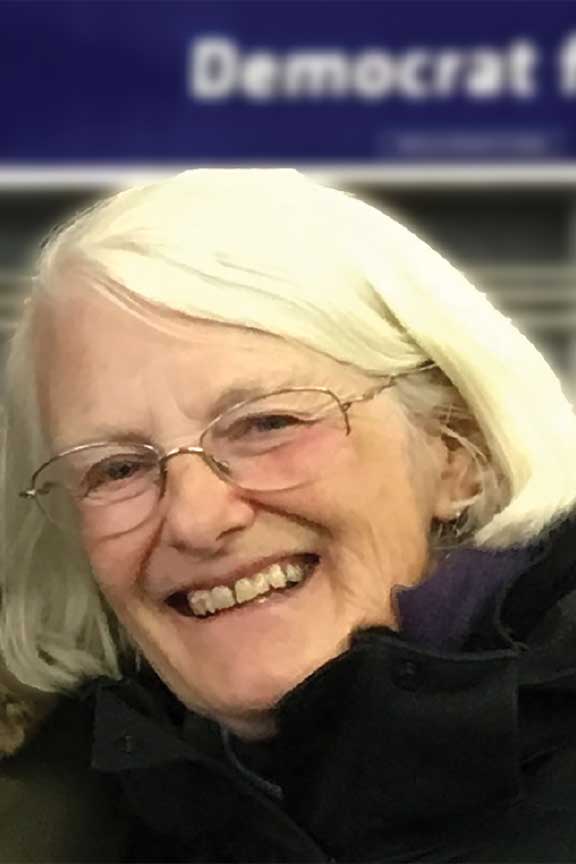
Frinde (Frances) Aldrich Maher is Professor Emerita of Education and Women’s Studies at Wheaton College in Norton, Massachusetts, where she taught for twenty-seven years, and a member of the Radical Teacher editorial board since 1984.
She grew up in Marblehead, on Boston’s North Shore, in a large inherited house her family could barely afford to heat, among summer people whose principal residences were in Boston and Chestnut Hill. Her father was an architect; the family were liberal Republicans and Protestant Brahmins of the noblesse oblige variety, related by first cousinship to the Rockefellers. She attended an all-girls boarding school, was a debutante, and went on to Radcliffe College, where she majored in American history and literature and was radicalized less by the curriculum than by the conversations in her off-campus living room.
After a term at Oxford she returned in 1965 to Boston and to John Maher, whom she married. She canvassed for welfare reform out of the Dudley Street Action Center in Roxbury, an SDS ERAP project, worked in a Somerville light bulb factory, sold socialist newspapers at factory gates, and in 1969, with John, moved into the orbit of the Progressive Labor Party. She took an MAT at the Harvard Graduate School of Education, taught American history at Wellesley High School from 1967 to 1969, at South Boston High School in 1970 and 1971, and at Brookline High School for five years, and was one of the authors of the four-volume Vietnam Curriculum published in 1968. Her doctorate, an EdD, was based on a study of the social studies teachers at Brookline High.
She joined the Wheaton faculty just as the college, then still all women, received a grant to integrate the study of women into the undergraduate curriculum, and became the first person in education to receive tenure there. With Mary Kay Thompson Tetreault she wrote The Feminist Classroom (Basic Books, 1994; expanded edition subtitled Dynamics of Gender, Race, and Privilege, 2001) and Privilege and Diversity in the Academy (2007). She retired in 2008, then spent twelve years counseling Harvard graduate students, largely young men and women of color and white women, through what she calls the Harvard syndrome of feeling like an imposter.
Her memoir, Class Encounters: A Memoir of the 1960s, was published by Tidepool Press the day after this interview was recorded. She lives in Cambridge and has two children and four grandchildren.