
The Interview
An oral history interview for Radical Teacher Interviewed by Michele Fazio December 20, 2022. The transcript has been lightly edited for readability.
Michele Fazio: So this next part, we’re going to talk more about how you became radicalized. Is there a particular moment that comes to mind, when you recognized that, or became radicalized?
Paul Lauter: Well, we partly have talked about that, having to do first with working with the AFSC in Philly, and getting involved in the marches outside of Philadelphia, in Chester I guess. And as I said, the influence of Allan Brick as a pacifist really was a major thing.
The one thing I haven’t mentioned was this. One of the things I did when I was first working with the AFSC as director of peace studies was that I went out to the University of Michigan to meet with, oh, it’ll come to me. Anyway, he and his wife, the two of them together, ran an institute for the study of conflict resolution. And while I was there I also met with Dick and Mickey Flacks. Dick was then a graduate student in sociology, and Mickey was working, I think, for a science magazine of some kind. And also with Tom Hayden. They had been involved, were involved, with Students for a Democratic Society, and they were among the people responsible for the development of the Port Huron Statement, the organizing statement of SDS. I really didn’t know anything about it at the time. But it sounded interesting.
And somebody, Tom or Dick or Mickey, someone asked me shortly thereafter, this was in early fall of 1963, SDS was going to have a meeting in Philadelphia of people who were working with, what was it called, doesn’t matter, but the part of SDS that was involved with community organizing, or at least thinking in that direction. There were always a couple of strands in SDS, one having to do with organizing on campuses and particularly against the war, and another having to do with people going out from campuses to organize in working-class and often Black communities, organizing around whatever the issues were in that particular community. That was ERAP, the Economic Research and Action Project, which was in part funded, as I recall, by a grant from the auto workers’ union.
I don’t remember exactly what the meeting was about, but whoever it was asked me whether people could crash in my apartment in Philly. I had this really quite small apartment. One room was more or less the size of this study I’m sitting in, maybe a little smaller. The other one was maybe a little bigger, but not much. So, two rooms. I had a single bed in the back one, and a bridge table and a couple of chairs in the front one. There was one of these built-in kitchens. And that was my apartment.
I said, well, I don’t know, I’ve never had any experience with this before, but why not, what the hell. So we made arrangements. I don’t remember how I got somebody a copy of the key. And I was out that night, on a date. I don’t know, maybe I went to a concert or something. But anyway, I got back at 11:30 or something like that, came into the apartment, and discovered that there were maybe eight or ten people asleep on the floor, in both rooms. And what attracted me about SDS was that nobody had preempted my bed. I thought that was pretty nice.
People got up early and went to their meeting, and it worked out just fine. There was nothing to be nervous about. But I got to know a few people, the Flackses in particular, because they were among the rather few people then in SDS who were married, as I would be for a very long time, and they were slightly older.
So, coincidence, Dick Flacks and I talk every other week. We will talk this afternoon at some point. So we’ve been friends since 1963. That’s a while, really. And we became particularly friendly when they moved to Chicago. He got a job in the sociology department at the University of Chicago. He’s a social psychologist, really. And while they lived on the south side, where the University of Chicago is, I lived on the near north side, and we got to know each other. I got to know a number of people from SDS, Todd Gitlin, the woman he was with at the time, Nancy Hollander, and others who were active with the project on the near north side. And one thing leads to another. I started going to SDS meetings.
You asked before about class consciousness. That, I think, was through meeting with people in SDS, that I began to think about class not only as a category of analysis but as a live reality. Not that it was so central in my experience at that point, but it was certainly very much a part of other people’s lives.
I don’t know if you’ve ever looked at the book that Dick and Mickey Flacks wrote, Making History / Making Blintzes. It’s a wonderful book. Rutgers University Press. Both of them came from Communist backgrounds. I didn’t know from Communists. I had no friends that I know of who were Communists, and I had the conventional American attitudes. Not that I held them with any enthusiasm, or deeply, but the natural American anti-communism that still suffuses this country. And I began to think differently, particularly after Dick was almost killed. Somebody, and they have never found out who, came into his office at the University of Chicago and smashed his head in with a hammer or something like that, and almost cut off his hand. He was really quite lucky to survive. And the police never did anything, really. You would think that would be something worthwhile for the police to do, and that was not the case. It was awful.
After that, and after a lot of friction with the sociology department at the University of Chicago, among other things, and I’ve written about that sufficiently, Dick and Mickey decided to go to California. He was offered a good job at UC Santa Barbara, where he has been ever since. Mickey died a couple of years ago. But both of them were really very influential in Santa Barbara in the development of what had been a very right-wing, conservative community into a thriving progressive community. Mickey worked particularly on housing issues, which I think are really very central in California. And Dick made his own place in the sociology department there, with a lot of very good people, and he does a weekly radio show there.
So Dick and Mickey in particular were for me very influential in thinking about, not rethinking, because I had never really thought about, the kinds of issues that SDS folks were concerned with, some of which had to do with race, and eventually with gender and sexuality, and some of which really had to do with class. And still do. There is an SDS online list of about 510 people, mostly people who were active in SDS during the sixties. And they do a variety of things. Most are not academics. Some are lawyers. Some still do community organizing. But they became, and they still are for me, a kind of reference group from whom I learned a lot.
I also became, in a funny way, peripherally involved with the organization itself. SDS initially was located in New York, and then in 1965 they moved the office to Chicago, to the south side, and then eventually to the west side, at the same time that I moved to Chicago. So I got involved, and I was elected to the, what’s it called, the National Interim Committee, the NIC. I don’t know exactly what we were supposed to do. We were supposed to in some sense have some supervisory function with regard to the national office. That would be what I would say. There was not much involved, but it was a very great learning experience for me, for a variety of reasons.
In particular, Paul Booth was, I think, the national secretary then. Paul died two or three years ago. I don’t know if you know his widow, who’s a wonderful woman named Heather Booth. There’s a film made about Heather. She’s a force of nature, I’ll tell you. Really amazing woman.
One of the things that Paul got me to do, or proposed and I did, was to write an SDS pamphlet on conscientious objection. It was a guide to CO status. I did a draft, and Paul sat down with me and examined the draft with me. It was the kind of learning experience that, at its best, if you teach English as we do, you do with students, to examine the implications of word choice, sentence structure. Talk about a close analysis of text. It was just amazing. I really learned an enormous amount from Paul, and in particular because he was, as I was not, very sensitive to the political implications of framing something in a particular way.
And particularly because I was working at the time for the American Friends Service Committee as the peace education secretary for the Chicago region. AFSC is a pacifist organization. SDS was not a pacifist organization, and it was not appropriate for me to be importing pacifism into the text, even though it was a text about conscientious objection, because SDS was very much involved, and I was very much involved, in the question of draft counseling and draft resistance and ultimately anti-war work. The pamphlet went out, and I really learned an enormous amount about the implications of language, politically, that I had never really thought about at all.
The other thing that Paul did was suggest to me that I should go and meet with this guy that I didn’t know anything about, who was a linguist named Chomsky. And I did do that. It must have been ’65 or ’66. I went East and met with Noam at Bickford’s in Harvard Square. I remember very distinctly. It may still be there, for all I know.
And we talked a lot, in particular about the possibility of putting together a statement to be signed by a lot of American intellectuals, modeled on the French statement that Camus and others had put together, mobilizing people to resist the war in Algeria. That was part of the process that led to the statement, “A Call to Resist Illegitimate Authority.”
There were really three threads, three streams, to that. One that Chomsky himself and others, including Louis, I think, there at MIT and elsewhere in Cambridge. Another that was organized by Bob Zevin, who was then a professor of economics at Columbia. And significantly another part of it organized and written by people at the Institute for Policy Studies, particularly Marcus Raskin and Arthur Waskow, who subsequently became a rabbi. And probably a couple of other settings too. Ultimately they came together into issuing this statement and getting signatures for it, and then ultimately having a press conference in New York at the Hilton hotel, which was a great disappointment. Not the Hilton hotel, the press conference.
But Paul Booth was the person who got me to talk with Chomsky and company, and therefore involved in this process of putting together the statement. It’s a good instance of the way in which individuals shape others, and not only in the way of thinking, but in what they do. Because that in turn led, after the press conference, Zevin had arranged for us to meet at Columbia, at the faculty club, and then we started this organization called RESIST, which exists to this day as a small foundation on the left. This was in 1967, so it’s a long history.
Louis and others thought that we should have Paul Potter, who was very active in SDS, and a wonderful person, as the executive of RESIST. But Paul did not want to do it, for whatever reason. He was perhaps even then ill, or he had other things on his mind. And so I became the national director of RESIST, and remained so for a number of years, even though I wasn’t necessarily involved on a day-to-day basis.
In any event, there’s no one thing that radicalizes a person from the kind of background I come from. Very different from Dick and Mickey Flacks, who came from families who were Reds, who were Communists, and it was their mother’s milk, so to speak, in Brooklyn. I think Dick was from Brooklyn and Mickey from the Bronx. That wasn’t true with me. I came from a family of Roosevelt Democrats who shared a certain basic liberalism and who were not activists. Nobody in my family was that.
But I learned, and became more and more active, and it fell on fertile ground, I have to say. I was always kind of anti-authoritarian. I remember one event in junior high school that took place the day I was supposed to go, and did go, to take the exam for Science. One of the assistant principals, they had two or three of them in my junior high school, and nasty people they were, put our whole class in detention because we were talking in the hall. Tell me, is that a ridiculous way of running a school? Well, but that was the point of the school, really, in many ways, as I would write about later. And I can remember pulling him out and calling him a Hitler for putting us in detention for talking in the hall. And then I went and took the exam for Science, which made me very nervous after this event.
So I was very anti-authoritarian, for reasons I have no idea about. But that was a major factor. And it’s the accumulation of certain things. Friendship. Learning from people you trust, like Paul Booth, and like the Flackses. Seeing models. I remember going to a debate about the draft in which Norman Thomas was debating some woman from some right-wing group, and being enormously impressed with Norman Thomas. I didn’t know anything about socialism or the Socialist Party. You learn from those.
I think it’s the accumulation of learning, of seeds that fall on somehow fertile ground. In my case, I think this feeling of marginalization, having to do with my secular Judaism and having to do with my ambiguous sexuality. And then the seeds growing. That, at least for me, is a kind of a theory.
Michele Fazio: So what does the word radical mean to you?
Paul Lauter: Well, first of all, questioning. I don’t assume the truth of anything, particularly what the people in authority lay out there. I’ll listen, indeed I want to hear. But I don’t automatically assume that the president or the assistant principal, or my parents I suppose, have the last word on anything. And that’s always been very fundamental.
And then, learning not to be afraid. Starting from the margins. Being a feminist at the beginning of the seventies, among men, and not worrying about it. I was very often the only man, or maybe one of two, but very often the only man at a women’s meeting, like at the American Studies Association or at the MLA, when the Women’s Commission would have a breakfast meeting, or the American Studies Association women’s committee. When I was president I appointed ours as chair of the women’s committee. And I hate to get up in the morning. I’d get up at 6:30 and there would be a breakfast meeting at 7, and they were always more interesting, I found, than the more academic sessions. And again, I learned a lot. It was interesting and fun to be there. So being open to things, being comfortable with being marginal, that accords with being radical.
And then putting the knowledge, the understanding, to practical use. For me that took two particular forms.
One was to become active in my union at Old Westbury, at the State University of New York, and to help organize and be the sort of leader of, what did we call ourselves, the Reform Caucus. Mac Nelson from Fredonia was one of the people, and some others who are retired but still active in a variety of ways. We were not the main focus, the central caucus of the statewide union. We were people who were pretty much social democrats, and we shared a lot with them, but we were also feminists, and we were also interested in students, and in race, in a more explicit way. I eventually was elected to be the vice president for academics, and then ran for president of the union. My life would have been very different if I had won. I lost by two votes. There’s a whole story about that not worth bothering with. But that was one implication of putting into practice the kinds of ideas about society, about country, and about academic work.
The other one had to do with the canon, and bringing about change, and that really began in the sixties for me. I’ve probably told this story a million times. In 1964, when I was part of Mississippi Summer, I brought with me a few books, three of which were by Black novelists. They were the only Black novelists I knew: Ellison, Wright, and Baldwin. And I taught Native Son to a freedom school class in Florence’s freedom school in Jackson. Most of the students in the freedom school class had never read a whole book before, and probably had never had a whole book before. And I had never taught those books, but I certainly knew about them.
And I remember after a class asking one of the SNCC staff people, I don’t remember who it was, actually, and saying, I know these three novels, who else should I be reading? And she said, well, you know, Paule Marshall, Brown Girl, Brownstones. Never heard of Paule Marshall, much less that novel. But I got hold of a copy of it pretty soon. Eventually the Feminist Press published that novel. And that began the process of reading writers I didn’t know anything about, Black writers. And that unfolded into the work of the Feminist Press, which began six years later. But that in turn unfolded more broadly into the whole question of what we call the canon, a term that was not in use when I was in graduate school, or for the most part in the 1960s. I’m trying to remember the guy, his name, Grossman, at Brandeis I recall, first introduced the concept of a literary canon.
And just as the movement ideas played out in the work of the union, so for me they played out enormously in the effort to transform the canon. That’s what ultimately led to the Reconstructing American Literature project, which led to the Heath Anthology, and so forth. Because it involved the whole question of what was important. What was important. Black lives matter, that’s important. And for me that meant, who was it important to read? What was it important to read about?
And it was not only important, it was enormously exciting. It’s very hard to evoke. I don’t know anybody who has altogether successfully done it, that sense of excitement in the early seventies. Florence had been invited to become a visiting professor, one term at Oberlin and one term at Denison. The term at Denison was fatal for our relationship, but that’s another story. But I remember the term at Oberlin, since I went with her on leave from Old Westbury, I don’t remember whether I had a sabbatical or not, it doesn’t matter, going into the stacks and looking in the American literature books for work by women writers. It was just incredibly exciting.
And then there were people like Tillie Olsen who would bring things to the attention of many of us. I just read last night, I was looking for something else, and came on something about Tillie’s course at Amherst that was circulated in the Feminist Press newsletter originally, or something like that. It was just a sense of discovery impossible to reproduce. What an amazing lift that was.
So it was not some abstract theoretical thing, like the theory that began to be prevalent in the 1980s, ways of approaching text in a different way. That really wasn’t what it was about. What it was about was what was important to read, who was important to read about, what people had written a hundred years before.
Tillie brought us, of course, Life in the Iron Mills. It was such an exciting experience. I’ve actually written about this. Florence wrote about it too, but mistakenly. She didn’t have the best memory in the world. We met Tillie in One Fifth Avenue, which was at that point a hotel, I think it’s a condo now. And she brought a very precious copy that she’d reproduced of Life in the Iron Mills. And we sat down and talked. I’d never heard of Rebecca Harding Davis. I knew vaguely about Richard Harding Davis, who always struck me as a not very interesting fiction writer.
After we met with her, Florence went off to meetings or whatever, and I took the train back to where the Feminist Press had its office, and our house. And Tillie had said, don’t read this in the evening. I never thought about that. So I read it that evening.
So that was the second way I was turning the movement, and what I learned in the movement, into actual practice. And of course the third was what became Radical Teacher.
We carried on the Radical Caucus. We put on sessions at the MLA. We did a conference. At some point, I remember Chris and I, when we were in graduate school at Yale, were friends with Gaddis Smith, who died a week or two ago, who was a significant diplomatic historian, really succeeded Sam Bemis. And I remember asking Gaddis about getting space at Yale for this conference that we ran.
And ultimately we began to do the magazine. We had had this newsletter, the Radical Caucus newsletter, and then the transition to the magazine was not an enormous break with what we’d been doing. We decided to do the magazine, and ultimately, after a while, decided to separate the magazine from the Radical Caucus.
The Radical Caucus was a radical caucus in English and the modern languages, and it focused on people who taught, almost all of them in colleges and universities, English or one of the modern languages. Sandra Dijkstra, whom you may or may not know, the significant literary agent, she was the literary agent for the first group of Asian American women writers, like Amy Tan. Sandy taught French at San Diego State. And others like that. But as we went on, it was clear that there were other people, in history and politics, who were interested in radical work, whatever we meant by it, and focusing on English and literature was too narrow. So we decided that we would separate out the magazine from the Radical Caucus. Which was fine. It worked out very well.
Some of us, Dick Ohmann and I in particular, and a couple of others, Susan O’Malley, and I’m trying to think of who else, but at least the three of us continued to be active in the Radical Caucus. I don’t remember whether Louis did or not. Maybe he did for a while and then stopped.
We continued to work in the Radical Caucus doing two things mostly: putting on sessions at the annual MLA, and also introducing resolutions. Various sectarian types got involved in the Radical Caucus, and particularly two really good people, Barbara Foley and Grover Furr, got involved. They were much more interested in passing resolutions, and some of them were very good and led in good directions, particularly those having to do with the adjunctification of the profession. And we learned to work together very well. I really respect them a lot. I don’t remember which group they’ve been affiliated with all these years, but they do very good work, and Barbara in particular is an excellent scholar on top of everything else, and a very nice person.
So we continued with that. But then we also accumulated more people who were interested in the magazine, and things grew. We had an older generation, Louis and Dick and Saul Slapikoff, and then a kind of not-quite-second generation, Susan O’Malley and Ramy Johnson and, oh God, the names. And then there are more like a third generation, like Joseph.
And the magazine has taken its own particular direction. I was reading recently, I don’t remember the name of the guy, let me see if I can bring it up. No, I’m not seeing it on my system. But it’s a very good and significant article by a guy who’s the national director, I think, of one of the third parties which essentially supports Democrats. His name has gone out of my head. But it’s an important article, and one of the things that makes it important is concrete suggestions about movement organizations. And one of those had to do with recruitment, and how important it was to recruit people who were sympathetic, he didn’t use that word, that’s mine, but people who fit with the culture of the organization. So that you are not in dispute about organizational matters and organizational culture. You could dispute and talk about and have differences of view and come to conclusions about what we ought to be doing.
And that, it seems to me, has been one of the realities of Radical Teacher. Very careful about thinking who would be good to have as part of this group, who would be easy with us and us with her or him. We made a couple of mistakes, of course, over the years, but it didn’t really matter that much. It’s allowed the magazine to continue, I think, in very good ways.
I always argued with Louis about this. I wanted Radical Teacher to be more activist. And Louis always felt that we could do the job of bringing the magazine out in a more regular fashion, and we could contribute things to thinking and teaching in particular, and to progressive ideas, but the more we got activist the less we would do so. We argued about that. I’m still persuaded by the desire to be more activist. But on the other hand, a lot of people who are involved in Radical Teacher are activists in other circumstances. James became very active in the union, for example, and now is president of the PSC. And Joseph is active in other dimensions. Susan was very active with UN organizations, all kinds of things.
Anyway, I’m going on here.
Michele Fazio: No, this is good. You’re covering several questions at once, so it’s great.
What do you value most about Radical Teacher?
Paul Lauter: Well, we’ve maintained our understanding that politics needs to be translated into practice in the classroom, and into practice in the university or college apart from the classroom. So that it’s all very well to have progressive ideas, but how do you translate those into what you teach and how you teach, and how teaching is organized, for better or for worse, in twenty-first century institutions. We’ve always maintained that understanding, and for me that has been enormously valuable.
That’s apart from the value of having a wonderful, supportive group of people. I think I mentioned before about Trinity’s English department. Well, equally valuable has been the people around Radical Teacher. We’ve continued. We support each other even as we drop away. It’s been quite amazing. People you could call on for a variety of needs and reasons. People have been very unstinting, very supportive, and I’m sure that others have felt similarly.
I know, for example, that Sarah has been very central to restarting the New York chapter of the American Studies Association, and until the intrusion of the pandemic, having events. But I’m sure that she feels that some of us were so supportive of that effort from the basis of Radical Teacher.
I think in general it’s a group that you can draw from and fall back on over many years. And in the political world that’s rare, because there have been so many divisions over the years. Like my department, which was called American Studies at Old Westbury, where we practically came to blows, and certainly the whole thing came apart, which was not atypical of academic departments or institutions. You think about SDS. And the New University Conference, which lasted three or four years and then totally came apart, which was very sad and unnecessary, in my view. But anyway, that’s what happens.
So it’s rare that an organization like Radical Teacher would continue over so many years, to exist, to be supportive, to be there, to be thinking, even when we have differences, and to work through them. That I value enormously, and I think other people do too. That’s the sense that I have, particularly among some of the older people, now retired. It’s a reference group of people we value and feel valued by.
Michele Fazio: Are there any memorable moments that you want to share?
Paul Lauter: There are many. I mentioned before the time I spent with Paul Booth working over the manuscript for the SDS pamphlet.
But the meetings. I always looked forward to them, with the pandemic coming in the way of that. For years, particularly after things essentially moved to Brooklyn. Originally we had the Radical Teacher meetings at Wesleyan, and Wesleyan has a center for retired faculty or something like that. I can’t remember what it’s called, but that’s where we had meetings. Dick had access to that, and before that he had access to the humanities center. So we could always look forward to driving there.
Once it moved to Brooklyn, then it was very funny. I had 92 Pacific Street. That’s still my card. It’s reasonably small, as those things tend to be. And what would always happen is Louis would stay with us, wherever, Annie and I had this apartment. I still have it, although Mike, my younger son, and his wife are living there. And I would meet or pick up Dick at his apartment on 111th Street, I guess, or he would come over, we would work it out, and the three of us would drive to Brooklyn to the Radical Teacher meeting.
It was always a joy, because both of them, Dick had a very funny, hilarious sense of humor, whereas Louis, and they had known each other before I knew either of them, because they were junior fellows at Harvard, enormously smart and knew far more than I. So I would drive and be part of the conversation. But the conversation was always so interesting, whatever we were talking about. And then we would arrive for the meeting and eat bagels and whatever, and see everybody else. Occasionally we would drive back, sometimes with somebody else.
And then even before that, when I was running, I once ran from my apartment, which is on Seventy-Seventh Street on the east side, to Susan’s house in Brooklyn, which is a fairly substantial run. I actually ran to one meeting in Middletown from my apartment in Hartford, and I can remember falling asleep at that meeting.
[to someone off camera] Good to see you too. Thank you for your patience.
Michele Fazio: I used to live in Middletown.
Paul Lauter: Did you really?
Michele Fazio: When I worked at St. Joseph. I was there for about a year and a half.
Paul Lauter: Well, so you know that running from where my apartment was to Middletown is not around the corner. But I was doing marathons. I was a lot skinnier than I am now. Somebody else from the Radical Teacher bunch ran marathons too, but I can’t remember who it was.
But going to the meeting and just seeing people was always a high point. It wasn’t one particular thing or another. It was the four times, or sometimes six times, over many times, that we would meet during the year. And then the farm meeting, which was always just a blast, particularly when we danced. What’s her name?
Michele Fazio: Pam?
Paul Lauter: Pam. Yeah, Pam. She is a real dancer. She didn’t exactly dance professionally, but she really did know dancing. I loved to dance with her. And we would do that on occasion.
Michele Fazio: It sounds like fun. I hope we can do this again.
Paul Lauter: Well, they did have a farm meeting at Joseph and Sophie’s place this last summer, and I hope maybe we’ll return to that in the future. It really did not work very well by Zoom, because some people are there and some people are on Zoom, and it’s really hard to hear.
So I can’t say, well, there was that event. There was just a lot of joy in getting together with people in this way. And there still is, even by Zoom, and even in some cases where I haven’t actually physically met people. There’s a lot of joy in it.
One of the things about RESIST. I think Louis decided to leave the board of RESIST when it was no longer a joy. I stayed on longer, but it became, it wasn’t negative, it wasn’t particularly sectarian infighting the way it became in SDS, but the joy was not there anymore. And there were too many differences. And so a number of us, Chomsky was one, and Louis, and I also, at one point, I can’t remember anymore. It continued as an organization, and continues to this day, and does good work. But it did not provide us with the kind of pleasure that a Radical Teacher meeting continues to provide.
Michele Fazio: Would you like to share any memories of Radical Teacher board members who are no longer with us?
Paul Lauter: Well, Harold. He and the woman he was married to, Marjorie, who became president of, I think, Emerson College, maybe, one of the colleges in the Boston area. They lived on the third floor. Louis and Ellen lived on the second floor, and then, after they split and Ellen left, Louis lived there. And for a long while Mary Hill lived on the first floor of that house in Cambridgeport.
Harold had a wonderful sense of humor. He wrote captions for cartoons for The New Yorker, among other places, and it was always a kick. He always had some cartoon captions in mind. Real fun. He was unfortunately also an alcoholic. They can be quite delightful. I was married to one for a long time, who was an alcoholic and really quite an amazing woman. But Harold was great fun.
Ramy Johnson was the one who did things like Radical Teacher T-shirts, and kept a supply of them, which many of us wore on various occasions. I always, when I was running, wore a Radical Teacher T-shirt, because when you’re really running out of steam in a marathon or a half marathon, I can remember running up the Grand Concourse, near where I grew up on Sheridan Avenue, four blocks from William Howard Taft High School, running up the Grand Concourse with my Radical Teacher T-shirt, running near the curb where the spectators were, because somebody, and often more than one person, would go, yeah, Radical Teacher.
Michele Fazio: I love that. Because, I don’t know if you remember, we saw each other in Chicago. I was having breakfast with Sherry Rankin, and you showed up. We were in the main hotel, and you showed up with your gym shorts on. You’d been running, and you had your Radical Teacher shirt. It’s a vivid memory. I think I was just about to go on the job market. And here comes Paul in his gym shorts and the Radical Teacher shirt.
Paul Lauter: As I recall, I had forgotten that I was supposed to be at that meeting, and I didn’t have time to go back to the hotel and change.
Michele Fazio: And everyone was looking like, who is this person? And I’m like, Heath Anthology. Paul Lauter.
Paul Lauter: The other thing that people shouted when I did the Bronx half was, are you going to do the whole one?
I loved those Radical Teacher T-shirts, and Ramy was the one who really ordered them initially, and kept them in stock, for many, many years, until he retired and moved elsewhere, and then ultimately passed away.
I think I mentioned this, not today but at some other time. There was this little group of us, four white guys, three Jews and a gentile, who constituted, I don’t know what you’d call it. We always had our hand in some technical part of Radical Teacher. Often I did the copy editing, for at least five or six years, or maybe even more. Not that we got the magazine out regularly three times a year, but when it was on paper, and fairly early on when we were still cutting and pasting to make changes, I was responsible for copy editing and a lot of stuff like that. Saul was always the person who took care of the mailing list and the bank account. Louis was the one who gathered in the subscriptions when the magazine cost a certain amount of money. Louis got the checks out of the post office box. Stuff like that. We were always involved at some level, just as Pam is the poetry editor, and Bob Rosen does the teaching notes, and somebody else, Ramy I think, for years did News for Educational Workers. I think we really have to restart that.
We were, I think, a significant reference group for each other. They’re all ultimately retired and ancient. Louis decided to pack it in after his ninety-first birthday. Dick died shortly after his ninetieth birthday, which we never really got to celebrate, and which made me extremely nervous when I approached my ninetieth birthday. I’m not going to make it. Well, I did.
It’s been somewhat of a decline, although Dick continued to do what he was doing, including writing theater scripts. But it was important for us to have each other, because we came out of somewhat different backgrounds. Saul was an old Red. He’d been a party member. Louis was never a party member, and was not happy with sectarians, but knew about the left, and was very smart about a lot. I could always ask him what the affiliation or the politics of a given person were. He always knew. They were all varied in different ways, very knowledgeable. So we formed a kind of support group without ever being formally that. And Saul for many years was the person who drove down to Middletown from Cambridge with three or four other people in the car. That was part of the élan of that group.
So it’s hard being the sole survivor, so to speak. But that’s the way it is.
Michele Fazio: So I have a few last questions. What made you become a teacher? And how do you feel about your experience as an educator?
Paul Lauter: It was rather accidental that I became a teacher.
I think I mentioned before that when I started college I started at the University of Rochester. I started there for two reasons. One was that it was in New York State, which meant that I could get, and did have, a New York State Regents scholarship. That’s the reason, even though I got admitted to the University of Chicago. In retrospect it might have been a good place to go, but I didn’t have the financial support. My parents didn’t have a lot of money. So I needed the financial support that I could get by going to a New York State institution. Columbia I never applied to, because they had a Jewish quota at Columbia, and it seemed to me that since I was not the valedictorian of my class at Science, I would never get in there anyway.
The other reason I went to Rochester was that I was in physics, and Rochester had a significant physics department, and not only a cyclotron that had been built with Navy money, a new cyclotron, but in the basement of the physics building they had an old cyclotron that dated back, I don’t know how many years, maybe to the thirties even. And ultimately I got to work with a graduate student who was doing his PhD there, who was rebuilding the cyclotron in the basement in order to do his PhD on medical isotopes. He never explained this quite to me, but he said he did not want to be part of the big thing in physics at that point, which was going to the bombs, going to Los Alamos. That’s not what he wanted to do. He wanted to work on isotopes. And I became his assistant, and did a variety of things.
So I was in physics when I left Rochester. I was really, talk about a square peg in a round hole. I didn’t know what I was doing, basically. I’d never been away from home. There’s no point in going into all of that, except that part of it had to do with being a Jewish boy from New York in a totally WASP setting.
Anyway, I got to NYU and I enrolled in what would be the next physics course. The problem was two for one. It was taught by a Dutchman whose English was not wonderful. But the other problem was that I needed to have differential equations in order to understand the physics that was going on in that class, because NYU had a different sequence of classes. And I didn’t know differential equations, and even though I was very good in math, I found it very difficult to figure them out. So I dropped out of that class and picked up a course in radio. I learned a lot about putting on programs and a little bit about the radio industry. And I might have gone on in communications or radio, which I liked. I like sports a lot. I might have become a sportscaster or something like that, who knows. Having just finished watching the World Cup.
But I was asked whether I was interested in the English honors program. And I was interviewed by the two faculty members who ran it, Ilse Lind, who was one of the few women in the NYU English department, and Charles Davis, who was the one Black faculty member in the English department. And I was accepted into the honors program in English, which was a two-year program at NYU.
Ultimately I did my undergraduate thesis. It was an index to first lines, and an essay, about E. E. Cummings. And the person I worked with, it turns out, was a lefty. It was Eda Lou Walton, who edited, she and a guy named Anderson edited, a very significant anthology, This Generation, which was one of the few that really had left-ish writers in it.
So there I was. I graduated, Phi Beta Kappa, et cetera. What am I going to do? I never thought about being a teacher. But I didn’t know what to do next. So, all right, what to do next? Go to graduate school. Get an advanced degree. It was about as thought out as that. And I was getting married, and, as I said before, there were only these two places that would hire you as a TA, UConn and Indiana. And then once you start rolling down that path, there you are.
If I had gotten diverted into something else, I might have found something else. A lot of my family was interested in theater and was involved in theater. My mother was an amateur actress in New York, when amateur theater was significant, in the thirties and early forties. Her brother, my uncle Irving Miller, and therefore of course Mitch Miller, not the Mitch Miller, but nevertheless, he became a lighting man on Broadway. He didn’t design the lighting, he implemented it. He worked for Century Lighting, as did his son and nephews. He got them jobs. He managed to get a union card. Theater unions were, and probably still are, very closed. You had to be the son or the nephew of somebody in the union to get a union card. And he managed to get one in Westchester, which enabled him to work in theater. My mother’s sister, who died of cancer when I was young, my sister is named after her, wrote theater reviews for, I think, Women’s Wear Daily.
So my family was very much interested in theater, and I might have done something theatrical. It just never presented itself, quite. I suppose if somebody had said to me, how about doing some summer stock when you graduate, or in between your junior and senior year, I might have done theater. It just didn’t happen.
So becoming a teacher was not a thought-out proposition, although it had its attractions, because it was stable. At least so I thought, before I got fired again and again. But, like my father’s position, it has a certain stability to it. And although my parents didn’t have a great deal of money, they had stability in the thirties, and that was not to be sneezed at at all. So teaching had that attraction.
Ultimately the opportunity of doing the kind of work that I was describing before became extremely attractive and really interesting. And it wasn’t so much working with younger people, although I like that. At Trinity I did a lot of work with older people, actually, because the introductory-level course in American studies, and the master’s program, were inhabited much more by people who had their undergraduate degrees and had been out for a while. Some were lawyers, some were teachers. And I loved working with them. That was just a kind of a joy, because we were the same generation, and it was fun. I learned from them, they learned from me. It was really good work. So that became a pleasure. But other than that, I don’t know. It just happened.
Michele Fazio: So, the last question, Paul. What are the biggest challenges facing higher education and teachers today? You spoke so much about growing up in the thirties, and radicalizing in the sixties, and really changing the discipline of literary studies for this generation. I’ve been so informed by your work. What do you think are the biggest challenges that teachers are facing today?
Paul Lauter: Well, I think the corruption of the workforce by adjunctification, and the reconstruction of higher education around managerial priorities. Chris Newfield, who is now the president of the MLA, has written very well about that, and has a couple of books actually, and he and another person do a regular column.
I think that has been extraordinarily destructive, not only of people’s lives but of the educational process, because it brought with it an ideology that claims that higher education is a personal thing, that you do the work in order to get a better job, and it’s all on you. And it has therefore utterly lost the meaning of educational institutions for society. I think that whole perspective, which is a right-wing perspective even among relatively moderate liberal, occasionally even progressive, managerial types, is enormously destructive of what education is really about, from my perspective.
I remember I was teaching at Old Westbury, and the guy, I cannot evoke his name, the guy who ran the bookstore at Old Westbury, and also at Stony Brook, he and his wife ran the bookstore. There wasn’t much of a bookstore, it was very small when we started, whenever it was, 1971 or so. Some of our students were actually living out at Stony Brook. Our name for it was Stoned Brook, by the way, which seemed appropriate. But it was like a little ghetto, because so many of our students were students of color, and they had some classes out there and some classes back at Old Westbury.
Anyway, he was coming up on his sixth year of teaching at Stony Brook, and they said, if we hire you for another year it’s tantamount to giving you tenure, and we’re not going to do that. We will hire you on a non-tenure-track appointment if you’re willing, or you can go elsewhere.
And I was very much involved in the union at Old Westbury, and we talked about that with him and with others. And we realized that if they can do that to him, they can do that, practically speaking, with anybody coming up who doesn’t have tenure already. I was very lucky. I got tenure the second year I was there. John Maguire, who was the president, regretted that, I’m sure, to his dying day.
But that was the beginning of this process of so-called non-tenure-track appointments. There were of course appointments of people to teach individual courses, like lawyers who love to teach, in a poorly-paid sort of way, and people in other fields. But that wasn’t their main source of income. They weren’t faculty members in that sense. The notion of full-time, non-tenure-track adjunct faculty seemed to me, and to a lot of people who were involved in the union, a total corruption of what was going on. And that remains, from my perspective, fifty years later, the primary undermining of the function and nature of higher education.
It’s not that adjunct faculty are not good faculty. Many of them are better than some of the people who hang around. But making them into freeway flyers, or folks who live in their cars, or having three jobs that you go racing from one to another, and getting food stamps and all the rest of it. Well, you can see, it just disgusted me, and it still does.
That was one of the reasons I think I was very supportive of the Radical Caucus. We did what we could. We got the MLA on record as opposing this, and I was trying to develop an opposition to it. That’s the reason that person got elected vice president and then president. It’s still out there, doing that work and supporting the unionizing organizations, and so forth.
But it’s part of a managerial revolution. I noticed some article in this morning’s New York Times about why things are out of shape in this country. Elon Musk and company are all of a piece with the manager who decides whether or not so-and-so will have a job for next term that starts in one week.
That was not the world that I entered into when I did enter into teaching. I never imagined this world, and it really makes me angry, as you can see me saying it. And so, to bring about change, I would have, if I had the capacity really to do that, been walking the picket line with the folks down at the New School before they settled, because they’re right. Those folks are being taken advantage of. As are the people at the University of California.
And that really had a lot to do, not just with the magazine and the Radical Caucus, but with the whole idea of what we were doing. Education is very central to the building of a decent society. And all this business in Florida, with this disgusting governor, whatever his name is, trying to undermine that, trying to undermine the role of teaching, that’s to me a very central part of today’s politics.
It’s why someone like, what’s her name, Diane Ravitch, is to me so significant. If she were not doing it, somebody else would have to do it. I thought about doing that. We tried for a while, by the way, to do a Radical Teacher blog. We did not succeed. We did not have the internal energy at that point to do it. I would love to see us doing it again. To really talk about what education means, why it’s significant, and particularly now, when there are so many battles over politics being fought on the ground of education.
So that also responds to the question about why the magazine is important to me. It has been because it’s a way of contesting for ground, and space, and meaning in society.
Michele Fazio: Paul, this was amazing. I only wish we could have had wine and cheese and crackers during this.
Paul Lauter: Well, I feel the spirit of the caucus moving in the room.
Michele Fazio: That’s good. And I will say, often when I do oral history interviews like this, the participant will have recollections that come like a week later. Write those down. I don’t know what Joseph is ultimately going to do with all of these, but I imagine there could be some really great excerpts that could come in the future.
Michele Fazio: I got a couple of pictures of you and me, I should send those to you. I took some when you got the lifetime achievement award. We may have had glasses of wine in our hands.
Paul Lauter: Yeah, well, that’s what you do at the MLA.
Michele Fazio: I’m excited to be part of Radical Teacher. Thank you for encouraging me.
Paul Lauter: Oh, I’m just delighted that you are. I really am so pleased.
Michele Fazio: Okay, take care.
Paul Lauter: You too. Bye bye.
About Paul Lauter
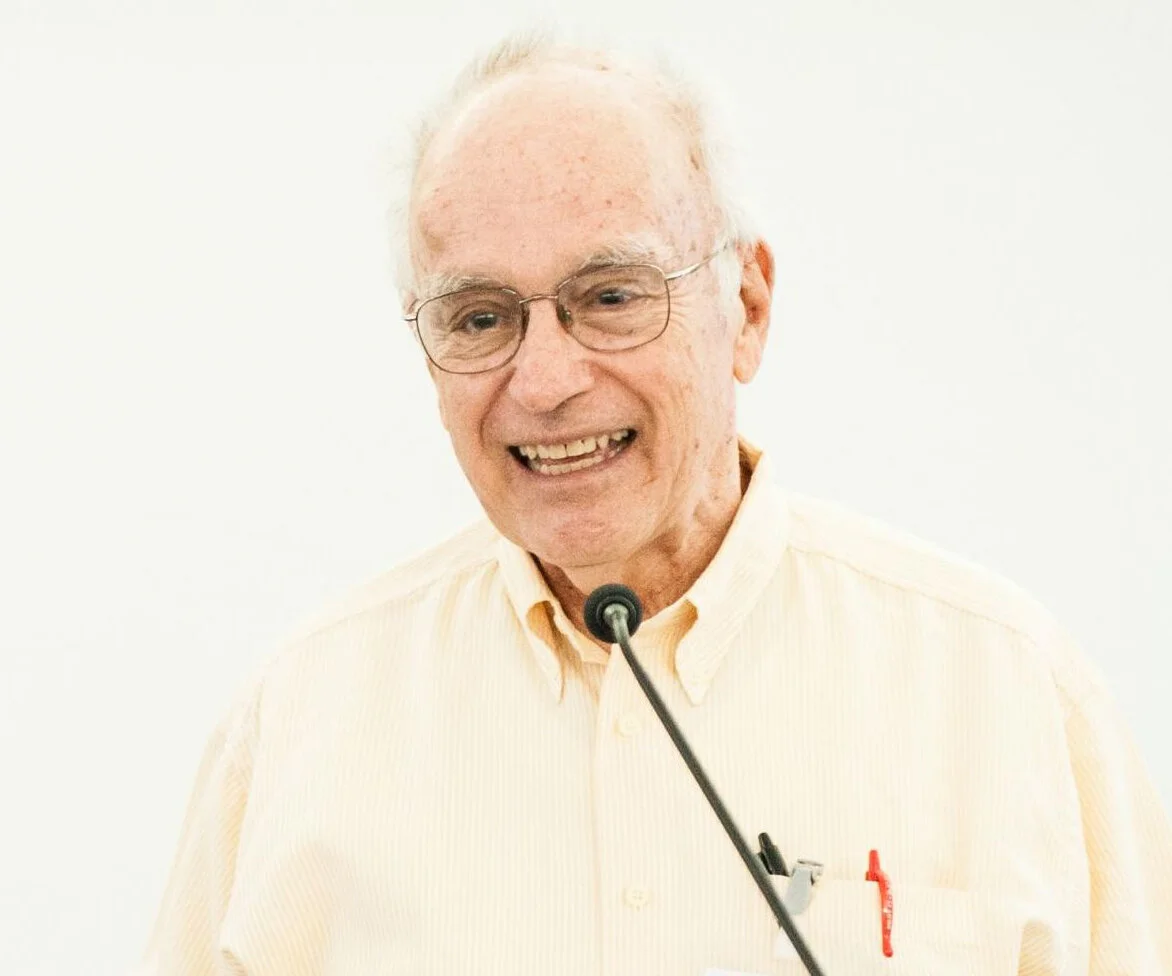
Paul Lauter, born in 1932 and raised on Sheridan Avenue in the Bronx, is the Allan K. and Gwendolyn Miles Smith Professor of Literature Emeritus at Trinity College in Hartford, a founding editor of Radical Teacher, a founder of the Feminist Press, and the founding general editor of The Heath Anthology of American Literature.
He entered the University of Rochester intending to study physics, transferred to NYU, and was drawn into its English honors program by Ilse Lind and Charles T. Davis. He took his PhD at Yale. In the 1960s he worked as peace education secretary and director of peace studies for the American Friends Service Committee in Philadelphia and Chicago, and later as executive director of the U.S. Servicemen’s Fund. He taught in freedom schools in Mississippi in 1964 and 1965, worked in Roosevelt University’s Upward Bound program, and in 1967 became director of the first community school project in the country, at Adams-Morgan in Washington, D.C. That same year he became national director of RESIST, the organization founded around “A Call to Resist Illegitimate Authority.”
In 1972 he returned to teaching at SUNY Old Westbury, an institution built to serve Black and Latino students and older women, where he was deeply involved in the faculty union and served as statewide vice president for academics. He moved to Trinity College in 1988 and taught there until his retirement in 2015, chairing the English department and directing American studies. He served as president of the American Studies Association.
His editorial and scholarly work has centered on the question of what counts as literature and who is worth reading. He initiated and directed the Reconstructing American Literature project at the Feminist Press in the late 1970s, work that led directly to the Heath Anthology, now in its seventh edition. His books include From Walden Pond to Jurassic Park: Activism, Culture, and American Studies, A History of American Working-Class Literature, and Our Sixties: An Activist’s History (2020). He has received the Modern Language Association’s Francis Andrew March Award for Distinguished Service and the Working-Class Studies Association’s Lifetime Achievement Award.